


 Reviewed By
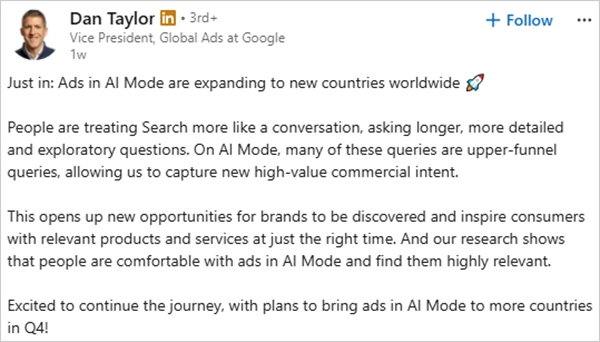
Dan Taylor, Vice President of Global Ads at Google, shared a post on LinkedIn saying Ads in AI Mode are expanding to new countries worldwide. According to the Google post on X, Google has expanded ads in AI Mode to select 10 new countries in English-speaking markets. Google can display ads within or alongside AI Overviews and AI Mode. It uses both direct query matching and contextual matching to serve ads. All ads are clearly labeled “Sponsored.”
Multiturn Ads in AI Mode
As people use Search more like a conversation, Google is bringing ads in AI Mode to more English-speaking markets. This announcement named 10 countries:
- Australia
- Canada
- India
- Kenya
- Malaysia
- New Zealand
- Nigeria
- Pakistan
- Philippines
- Singapore
Google help documentation says ads in AI Overviews and AI Mode are available in English in the United States and select English-speaking markets. It also says availability is expanding to more countries, territories, and languages over time.
Ads in Follow-Up Questions
These can appear during ongoing conversations in AI Mode, including across follow-up questions.
For illustration: A user asks AI Mode, “Why is my swimming pool green?” Google explains the cause may be algae and outlines steps like water testing, brushing, and vacuuming debris. Then the user asks a follow-up question, “How can I clean it?” In response, Google AI may show relevant “Sponsored” ads for algae treatment kits or pool cleaning equipment.
Where Ads Appear
Google Search offers generative AI experiences for different types of questions. AI Overviews give a quick snapshot, while AI Mode supports multi-turn conversation and comparisons.
Labeling and Placement: When a search or conversation has commercial relevance, ads can appear within or alongside these AI-generated responses, including across follow-up questions in AI Mode. Paid advertisements do not influence organic responses generated by Google AI. Standard ads on the Google Search results page can also continue to appear above or below AI Overviews.
How Google Matches Ads: Google uses two methods to match ads.
- Query Matching: Matches directly to the user’s query when it already expresses clear commercial intent.
- Contextual Matching: It’s applied to longer, exploratory, and conversational questions. Use both the user query and AI-generated responses to identify relevant advertising opportunities.
AI Max for Search term, broad match, Shopping, and Performance Max support both methods. Exact and phrase match keywords are eligible only for direct commercial searches.
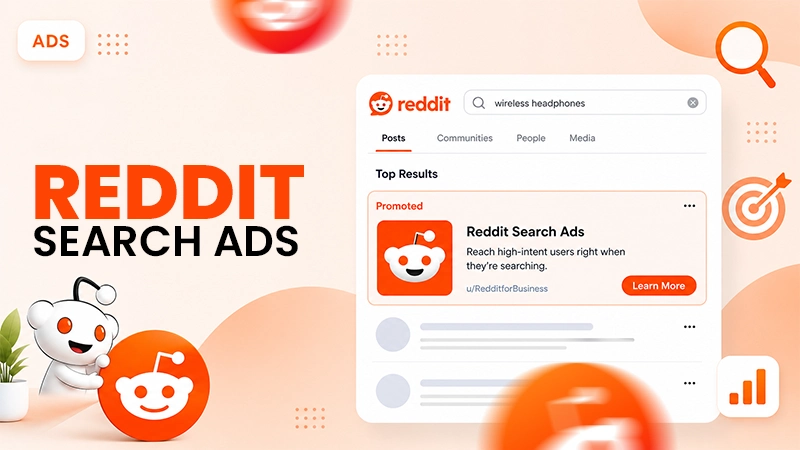
Read More – Reddit Search Ads: Platform Begins Testing Ad Placements in Search
What Advertisers Need to Know
Existing accounts and campaigns guardrails, such as negative keywords and asset pinning, continue to apply to ads.
Which Campaign Types Are Eligible
Advertisers don’t need to create separate campaigns; existing Search, Shopping, and Performance Max campaigns are automatically eligible. Text ads and Shopping ads can appear now. Availability is expanding across countries and languages.
Reporting
Performance metrics for ads are included in standard Google Ads campaign reports.
Campaign Reports: Queries that trigger ads are included in impressions, clicks, conversions, and cost in all existing campaign reporting.
Search Terms Reports: Queries are included in aggregate in the Search Term Report.
Suggested Read: What’s Rolling Out in Google November 2026 Core Update
Best Practices for Advertisers
Google recommends four key optimization strategies.
- Use AI-powered targeting.
- Use Smart Bidding with strong conversion data.
- Optimize ad assets and landing pages.
- Keep Merchant Center product feeds complete and fresh.
Final Words
Ads in AI Overviews and AI Mode give advertisers a new way to reach people as they explore and compare options. Text and Shopping ads can appear today, and Google is experimenting with local inventory and vehicle ads. Advertisers should prioritize AI-powered targeting, Smart Bidding with strong conversion data, and high-quality campaign assets. Together, these help campaigns reach users through both direct searches and conversational questions.
Leave a Comment
Your email address will not be published. Required fields are marked *