

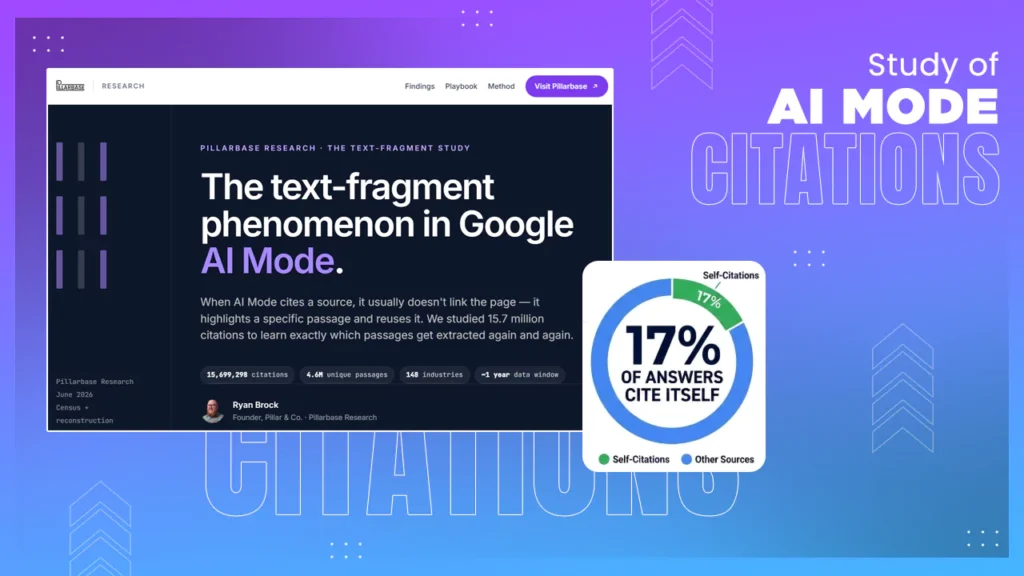
Pillarbase published a blog titled “The text-fragment phenomenon in Google AI Mode,” by Ryan Brock, Founder of Pillar and Co. · Pillarbase Research, revealing findings from a year-long analysis.
This 15.7 Million AI Mode Citation Study provided many ground-breaking revelations that are highly essential for SEOs to learn and make necessary improvements in their strategies.
Besides, the opinions and statements of the digital marketers from across the globe will further deepen the understanding.
What Does the AI Mode Citation Study Reveal?
Pillarbase’s report studied 15.7 million citations and provided in-depth inferences.
The study says that when a query is searched in AI mode, it appends a fragment of the text to the link, which, when clicked, takes the user to that particular passage extracted from the webpage. (Explained diagrammatically in the image below)
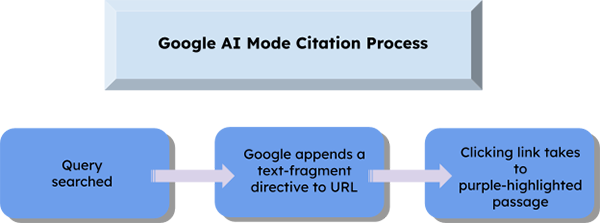
These highlighted-passage URLs are called Variants and can be reused to answer multiple queries.
Such text-fragment highlights appeared in 47.7% of the citations, while the remaining citations appeared as regular links.
The salient facts about the study are:
- 47.7% of the total citations analyzed had a text-fragment highlight.
- 4.6 million distinct highlighted passages (variants) observed.
- 2.7 million different base pages cited.
The study also provided a few key observations.
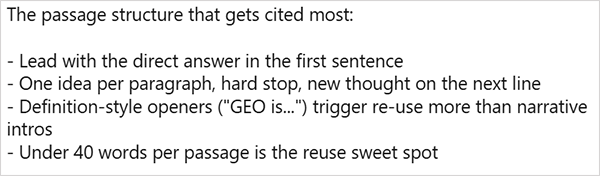
Firstly, it said those passages that get cited have 2 things in common: they start with the answer and have self-contained information.
Thus, stuffing the answer in the middle of the passage won’t be a smart move.
Secondly, one extracted passage can be used to answer multiple queries. Although the study says reusing a passage is not a thumb rule, rather around 81% of the passages are used just once.
Another correlation the study derived was that:

What Do Digital Markets Say?
The digital marketing community agreed with the revelation of the study and expressed their views to enrich the knowledge.
Danny Conlon from Ignite Visibility has covered this analysis in her new video and suggested the following way forward.
- Use question-based headings.
- Answer the query stated in the heading in the first sentence of the paragraph.
- Make every para clear enough to stand on its own.
She reiterated the Modus operandi for a good article, i.e., the best content is the one that is understood conveniently, easy to extract, and sorts out the user’s query.
Also, Michael Doyle, founder of Top4 Technology and an LLM SEO and GEO expert, referred to this study in a LinkedIn post and extended his valuable views, saying:
“AI visibility isn’t separate from SEO. It compounds on it.”
Moreover, Toni Koraza, Founder at MADX, has discussed this report in his LinkedIn post and suggested some key points to keep in mind while structuring a passage. These are:
End Note
The crux of this AI Mode citation study is that Google AI Mode extracts the passage from the entire content rather than citing the webpage and shows it on the search results, while maintaining the chances of reusing it wherever possible.
Hence, focus on providing unique, informational, valuable, and original research to get cited in AI.
Next Read: Google AI Search Clicks Statement: Claims AI Features Send Billions of Clicks Every Week

Leave a Comment
Your email address will not be published. Required fields are marked *