

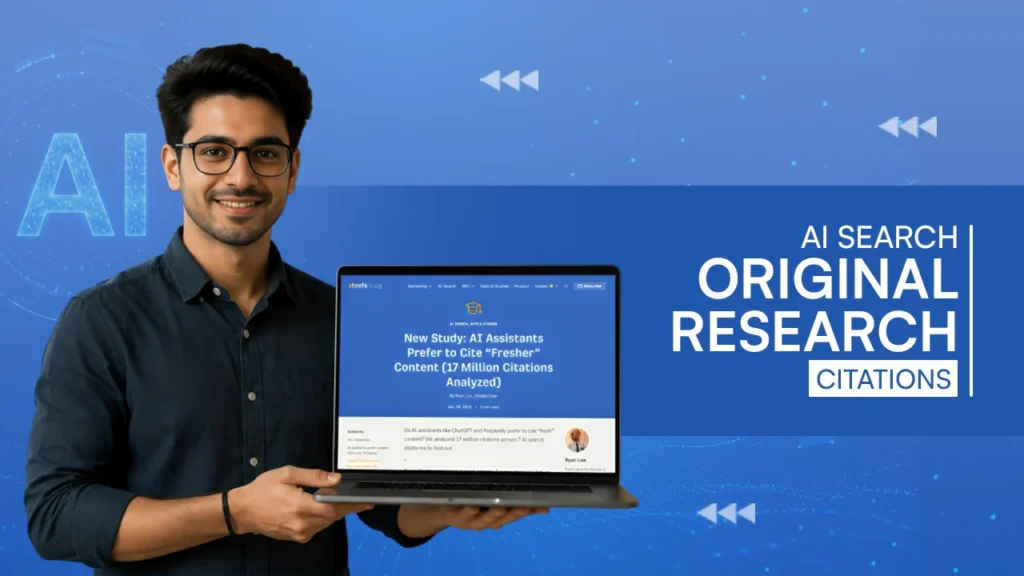
What is the best strategy to get traffic?-
Post valuable content. (That’s what Google says.)
But what’s even better? Post original content. (Studies say)
AI search original research citations are gradually drawing the focus of the LLMs and are frequently getting cited in their responses.
The truths and facts around it are way more interesting.
Why Does AI Search Cite Original Research?
The simple logic is that when you post original data, it gets into the references of other web pages and gradually gets attention over time.
Let’s understand this through the combination of facts and stats.
Neil Patel, the renowned digital marketer and founder of NP Digital, has explicitly mentioned this through a statistical overview. See the infographic.
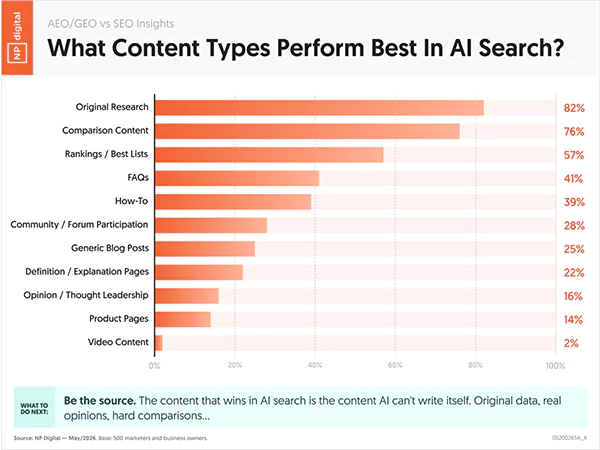
It clearly implies that original data has a probability of 82% of getting cited on AI platforms.
Another major study conducted by Yext reveals that Websites featuring original and fresh content earn an average of 4.31 citations per URL as compared to 2.46 for directory listings.
Not only this, Ahref’s’ analysis of 17 million citations infers that AI assistants prefer fresher content. This not only means original research is favored, but also that adding new content to the already published information will attract LLMs’ attention.
But merely publishing original firsthand content won’t automatically bring the page to the top citations on AI.
Also Read: Evergreen Content or Trending Themes for SEO. Which One to Choose?
Why Different AI Models Cite Different Sources
There might be a situation where your original research might get cited in one AI chatbot but not in the other.
This happens for a reason.
All LLMs follow different algorithms to retrieve a productive answer to the queries.
Semrush has conducted research analyzing 150K AI citations and found that a few citations overlapped. This indicates the difference in their data extraction and citation process among the AI agents.
In this perspective, another effective study by The Digital Bloom provides the sources that LLMs prefer to extract relevant answers.
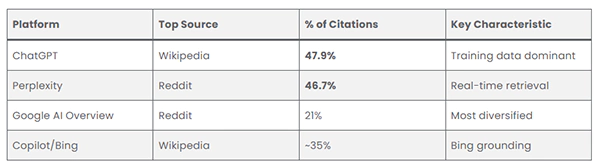
Besides the algorithmic variation, there might be other reasons for your original data not getting cited.
However, all these gaps can be filled through smart efforts.
How To Fill The Gaps to Get Original Research Cited In AI Results?
The core difference between search engines and LLMs is that search engines rank the pages, but LLMs provide answers citing the most relevant source.
This doesn’t mean SEO is dead, but it’s changing so fast that people can’t keep up with its pace. And now AEO, GEO, AIO, and others are coming out of it, making strategy development a daunting challenge in itself.
To align with the contemporary trends and get original data in those few citation spots, you need to follow some tweaks.
- You need to restructure content for better AI visibility and get it cited promptly.
Good Structure + Skimmable Content ⇨ Easier For AI To Extract Informaiton - Also map the subqueries around the core idea you are approaching. Your original content must also contain the linked facets around the core topic to get holistic coverage of the topic.
- Go with an improved keyword strategy. If you own a brand and provide some unique product or service, then choose keywords with higher buyer intent like best note-making AI tools.
The actual need is to move from the most optimised page to the most relevant content.
Concluding Remarks
AI search picking original research in citations is now a widely accepted gospel in digital marketing. But exhibiting it in a structured pattern is the pressing need to reap its true value, as reiterated by Andrew Holland, a notable PR Strategist and GEO Expert. So a harmonious blend of content and quality will work wonders.
Next Read: How AI Chooses Local Businesses: SEO Strategies for Google AI & ChatGPT

Leave a Comment
Your email address will not be published. Required fields are marked *