

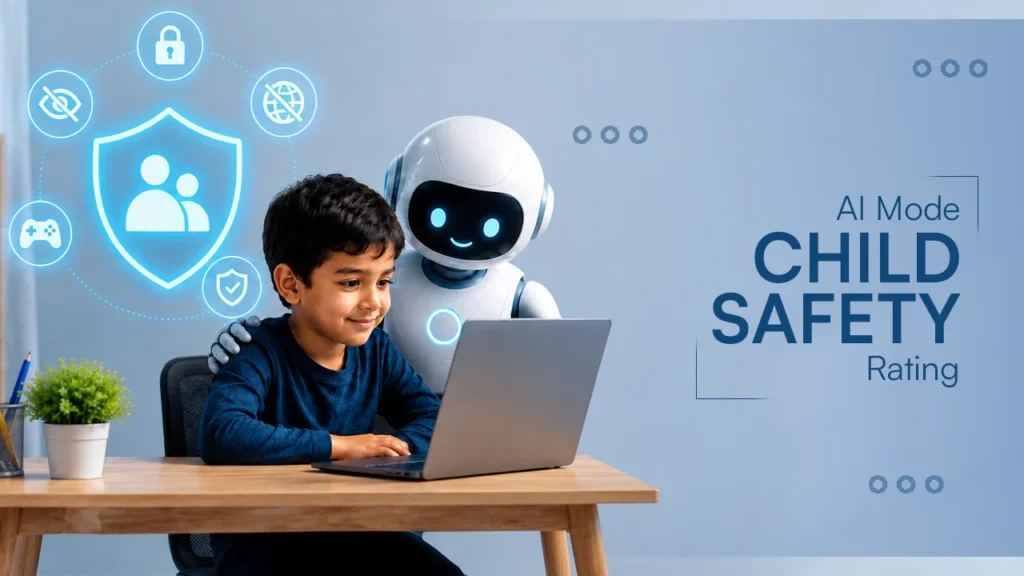
Youth AI Safety Institute at Common Sense Media, a California-based nonprofit, has released a report, “Google Search: AI Overview & AI Mode,” raising concerns over child safety while using Google AI features, especially Google AI Mode and AI Overviews.
The report has been featured on many top news and blog sites, pointing toward the gravity of the issue and challenges posed.
Here is the crisp breakdown of the vital facets of the report and linked perspectives.
Key Findings and Recommendations of the AI Mode Child Safety Rating Report
The AI Mode child safety rating analysis was backed by tests conducted between May 16 and July 1 over Google’s AI features on search, AI Overview, and AI Mode, which considered a total of 2,600 tested interactions and also examined 2,100+ source citations.
This report analyzed both AI Overview and AI Mode and concluded:
“They performed poorly on seven of our eight established AI Principles, and specifically failed all of our tested severe-harm Red Lines.”
The report says the issue is severe because Google is ubiquitous and accessible on almost all smartphones and systems.
Some notable observations of the report revealed by Common Sense Media that flagged prominent issues with Google AI mode and AI overview are:
- They showed how to create deepfakes.
- Did not recognise the need to answer a query based on the age, i.e., a query is answered in absolutely the same manner for a 9-year-old and a 17-year-old irrespective of their cognitive abilities.
- Both AI features provide even incorrect information with high confidence.
- Provide 90% accuracy on stable and breaking new queries.
- Completed every requested homework assignment, thus jeopardising the learning process of the students.
- Below-par handling of queries involving mental health issues
In this perspective, Robbie Torney, Head of AI and Digital Assessments at the Youth AI Safety Institute, has opined that:
“What we found is a product that fails kids at the moments that matter most: It misses clear signs of a kid in crisis, validates disordered eating, celebrates substance use, completes homework on demand, and gives wrong answers as confidently as right ones.”
Considering these concerns, the report has extended a few recommendations to negate their impact. These are:
- Allow schools and parents to turn off AI features in the devices used by kids.
- Implement U13 and U18 age distinction features.
- Build and deploy standardized, evidence-based crisis response language.
- Use design cues and explicit language instead of footnote-style citation.
Suggested Reads: 1 Out Of 3 Queries In Google AI Mode Show Ads, Says Study
What is Google Framework for Child Safety?
Last year, Google released its Public Policy through the document titled “Responsible AI and Child Sexual Abuse and Exploitation Online,” affirming its collaboration and collective approach in addressing the menace.
Prior to that, Google had posted a blog titled “An update on our child safety efforts and commitments” by Susan Jasper, VP, Trust & Safety Solutions, in which it outlines its strategy in handling child safety risks, which included:
- Training datasets by integrating hash-matching and child safety classifiers.
- Identifying CSAE-seeking prompts through machine learning.
- Adversarial testing across text, image, video, and audio.
- Engaging with third-party experts.
Also, Google’s Growing Up in the Digital Age Summit was held in Dublin in March this year, which attracted global attention. The key takeaways of the summit are:
- Ensuring more safety on Google and YouTube
- Improvements in family links for children to have safe access to Google features.
- $20 million USD for teen digital well-being.
- Introduced new principles and creators’ guide.
- Safer and smarter age assurance.
The Leading Opinions
The impact of AI on child safety has been a long-standing issue yet to be resolved.
However, some notable steps have been taken, like the one mentioned by Nina Jane Patel, a renowned author and the creator of Quantum Child™ Framework, concerning the penalties on Meta.
Also, Eduardo Ordax, AI GTM Lead at AWS, has posted a video about the risks of AI and cautioned by saying, “So use AI, but use it responsibly.”
Final Words
AI has a multidimensional impact on all its users, regardless of age, group, gender, nationality, or any other factor. However, constant supervision, sincere guidelines, and ensuring stricter adherence to the set rules might work in checking the cons of AI Mode child safety rating issue.
What we must keep in mind are the views of Elon Musk, who said,
“The consequences of AI going wrong are severe, so we have to be proactive rather than reactive.”
Next Read: Google Rolls Out Top Stories Carousel in AI Overviews: What Publishers Need to Know

Leave a Comment
Your email address will not be published. Required fields are marked *