


 Reviewed By
Keywords are nothing but terms or phrases used by people to search for something on search engines, like Google, Bing, etc. When these terms become repetitive in use for a particular purpose, they are called keywords. According to various categories, there are different types of keywords in SEO. The 8 major ones are discussed below.
Learning about them in detail will help your SEO efforts in various ways, as revealed at the end of this article. Hence, let’s begin.
Types of Keywords in SEO by Length
By length, we generally have two types of keywords in SEO, namely, short-tail and long-tail. Short-tail keywords are shorter in length than long-tail keywords in terms of the words they comprise. However, that is not the reason behind their unique naming! You will learn more about it in the following headings.
1. Short-Tail
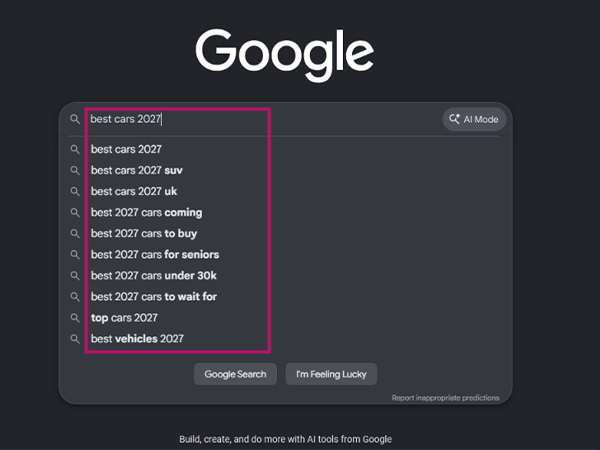
Short-tail keywords are normally 2 to 3 words in length, even though some can go up to 4 words (look at the image above). Some other Ideal examples in this category are as follows.
- Life insurance
- Health insurance
- Cooking
- Travel tips
- Lemon recipe ideas
- Best yoga poses
- Best smartphones 2027
- Healthy breakfast recipes
Short-tail keywords contain the following characteristic features.
| Features | Short-Tail Keywords |
| Length of keywords | 1-3 words |
| Specificity | Very broad and general |
| Search volume | Higher |
| Popularity | Higher, due to ease of typing |
| Competition | Higher |
| Conversion rate | Lower |
| Traffic potential | Higher |
| Click-through rate (CTR) | Lower |
| Ranking difficulty | Higher, due to high competition |
| Cost per click CPC | Higher |
| User intent | Broad and not specific (vague) |
| Content needed | Comprehensive, covering all the major search intents possible |
| SEO strategy | Suitable for websites covering various topics under the concerned broad field |
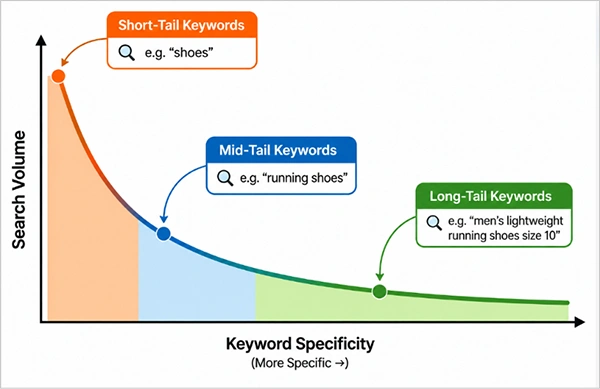
Did you know? Short-tail keywords are called short-tail not because they contain only a few words. But that is so because of their position in the “search demand” curve provided in the image above.
This curve represents search volume and keyword specificity on its X and Y axes, respectively. The highly popular and short-length searches are found near the top of the Y-axis, which is the place where you find no or little tail element as compared to the area going towards the end of the X-axis.
Note that 👉 for more traffic and better rankings, you have to learn more than just the basics of how to do keyword research!
2. Long-Tail
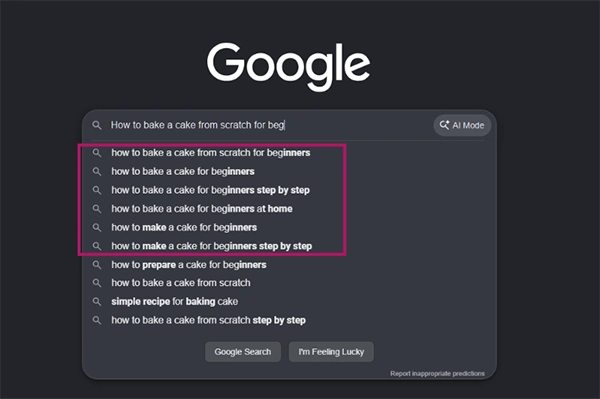
Long-tail keywords are found towards the end of the X-axis (to your right) in the search demand curve. Some ideal examples of these keywords are:
- How to delete your Facebook account after logging in
- How to grow your YouTube channel from scratch
- What are the major SEO factors that are responsible for bringing in the most traffic?
- How to do keyword research in 2027
These keyword types are longer in length and much more specific. Consider all of the key features in the table below.
| Features | Long-Tail Keywords |
| Length of keywords | Longer than 3 or 4 words |
| Specificity | Highly specific |
| Search volume | Lower |
| Popularity | Lower |
| Competition | Lower |
| Conversion rate | Higher |
| Traffic potential | Lower |
| Click-through rate (CTR) | Higher due to being relevant queries |
| Ranking difficulty | Easier |
| Cost per click CPC | Lower |
| User intent | More specific |
| Content needed | Niche focused |
| SEO strategy | Must be covered by sites that cover parent keywords |
Also Read: 15 Important Local SEO Tools Every Business Should Use in 2027
Types of SEO Keywords by Search Intent
According to the search intent, there are mainly four types of keywords in SEO. These are informational, navigational, commercial, and transactional. Have a quick look at the following table.
| Keywords by Search Intent | What Searchers are Looking for |
| Informational | Searchers looking for information |
| Navigational | Searchers accessing something they already know, i.e., YouTube or Amazon |
| Commercial | Searchers looking for information comparing services or products |
| Transactional | Searchers ready to take an action over the internet |
Each one of these four keyword types is explained in detail below with practical examples.
1. Informational
Informational queries or keywords are used by people when they need to learn about something. In short, they are looking for some piece of information.
For example, suppose you are planning to add a cup of coffee to your morning breakfast. But you are not sure how that would impact the nutritional profile of your healthy breakfast. Thus, you might search on Google or any other search engine, like
- “Is it safe to add a cup of coffee to my healthy breakfast?”
- “Negative consequences of having coffee with breakfast”
And just 2 or 3 years ago, Google would have given you a list of blogs and articles in response to these queries. But now, you get a straightforward AI overview, which satisfies the intention of your keyword or search query instantly.
Consider the following AI response in relation to “Negative consequences of having coffee with breakfast”
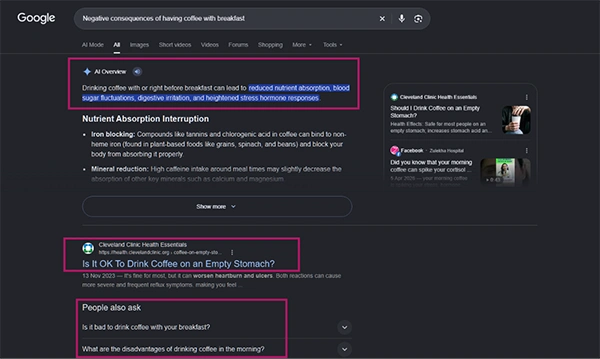
All of the results within rectangles (image above) contain information that a searcher needs. That has been the nature of informational long-tail search queries. However, people can also use short informational keywords like the following.
- Coffee calories
- Coffee benefits
- National coffee day, etc.
Mistake to avoid: Many beginners think that informational queries or keywords are of no use, as there is almost zero chance of conversion. However, that is not true. Searchers after information are at the awareness level of the sales funnel. Brands at this stage make sure that they drive the person in by providing quality information so that they can later pitch in and drive the conversion. Capturing leads earlier this way is one of the best Google Ads lead quality tips.
2. Navigational
Now, we have come to the next concept in our discussion on keyword types by search intent. And it is the navigational keyword. The intention behind these keywords is to navigate somewhere and, more precisely, the searchers already know the brand.
For example, millions of people know that Amazon is a big e-commerce brand. Thus, they all, from time to time, type in “Amazon” and hit the Enter button on their laptop screens. The intent is simple. They all want to go to the official website of Amazon. Look at the screenshot below.
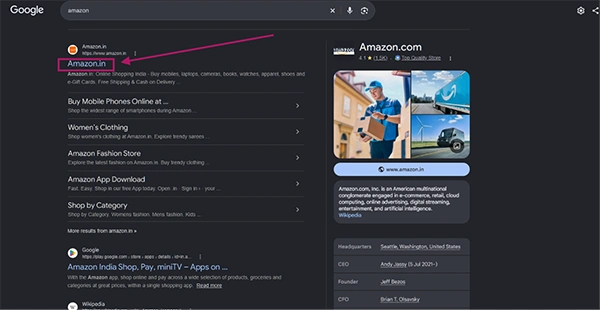
That is what a navigational keyword looks like.
3. Commercial
Commercial keywords are used by people when they want to draw comparisons among brands, products, or services. They read comparative analyses from site to site so that they can make an informed decision before making the final transaction.
People behind these searches often plan on making purchases sooner. Marketers often attract buyers at this stage in the sales funnel by providing content in the form of comparisons, reviews, listicles, etc.
Have a look at the example in the following screenshot.
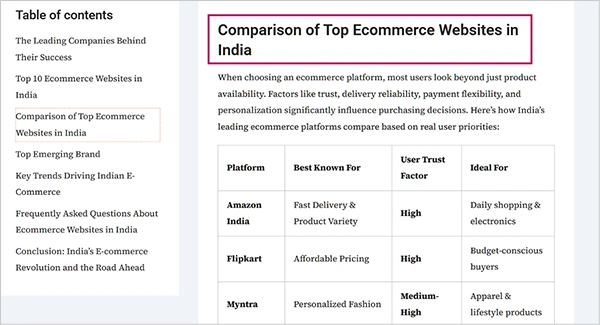
Other examples of commercial keywords are as follows.
- iPhone 15 vs Samsung S24
- Dell vs HP
- Best laptop for students
- Best chair brand for office work
Did you know: Most people confuse informational and commercial keywords. That is because, in both, the searcher wants information. However, the intent of desiring this information is different. The former is for satisfying sheer curiosity, while the latter is to help decide which one is a better option to make a transaction, i.e., buying.
4. Transactional
Transactional keyword types come 4th on our list based on search intent. A transactional keyword is typed by someone who is ready to perform a specific type of action. The action or transaction doesn’t always have to be a purchase only. It could also be a sign-up, a booking, publishing a review of the brand, etc.
Such keywords are served by SEO experts with highly specific landing or product pages with clear calls to action. Paid ads are also run in the same context so as to help buyers take immediate actions.
Common examples of transactional keywords are:
- Sugar-free cakes shop nearby for home delivery
- Zomato lunch options (searched before lunch)
- Opening a Kotak bank account
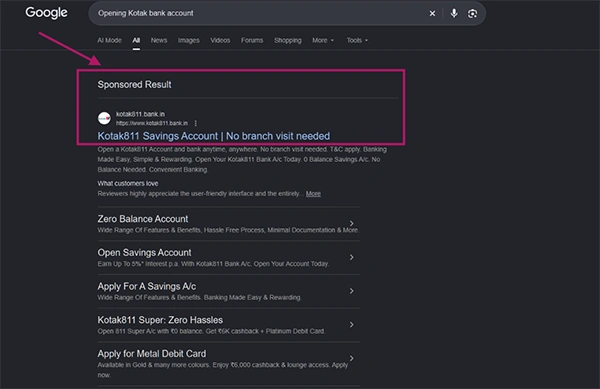
In a single line, whenever a person just wants to complete a specific action online, the keyword used is a transactional one.
Did you know? How much your website engages with local commercial and transactional keywords is also one of the key local search ranking signals. So, you don’t want to miss out on this factor for better local rankings.
Also Read: Google Search Console Adds New Multimodal Search Filter
Other Types of Keywords
Now, we have come to the final part of our discussion on types of keywords in SEO. Here, we will talk about local and seasonal keywords. Learn more about these types in the subheadings below.
1. Local
Local keywords are also known as geo-targeted keywords. Their key characteristic is that they contain a location identifier, which could be a city name, region, or “near me” at the end of the query.
Have a look at the screenshot below.
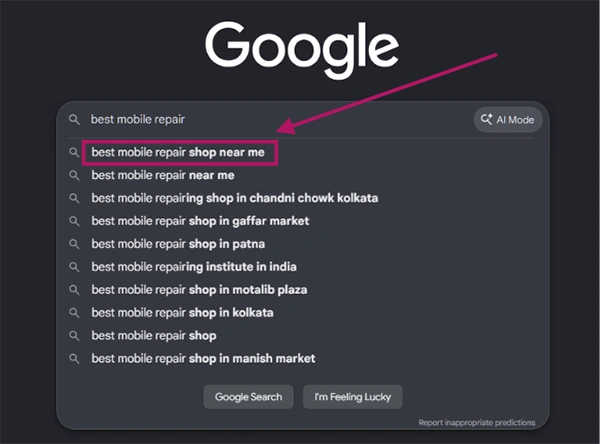
The most popular local keywords are always created with the use of the “near me” phrase, as shown in the image above. Other examples are listed below to provide you an idea.
- Italian restaurants in Brooklyn
- Hair salon downtown Chicago
- Towing service south Austin
- Best car repair in Manhattan
- Best wine shop in Queens
2. Seasonal
The keyword types that are only used to make searches in search engines at a particular time every year, for example, during holidays, events, or specific trends, are called seasonal keywords.
For example, when Christmas approaches, people start searching for “best Christmas gift ideas.” Or if winter is about to come, the volume on keywords like “best winter jackets” or “new stylish winter wear” will go up.
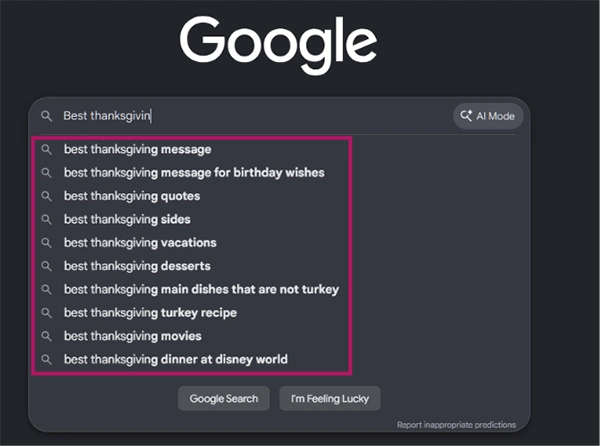
The above image shows autosuggestions for related seasonal keywords when someone types in Thanksgiving-related topics into the search bar! That is how you can learn about what is being searched during a particular holiday or public festival.
Google autosuggestion is the best way to get to key seasonal keywords.
Also Read: Technical SEO Checklist 2026: What Basic Requirements a Site Must Meet
Why Is Learning Different Types of Keywords in SEO Important?
At this point, you might ask why even bother learning about different types of SEO keywords. What is the use of all this information? That is why this section. Here, see how having this information in your head as an SEO can improve your marketing and sales efforts.
- Targeting the right search intent: Learning about different types of keywords helps you identify search intent and the audience behind it better. That means you know what your audience wants!
For example, if a person searches “cars vs bikes which one is better for personal use”, you know you need to keep the tone commercial, as it is a commercial keyword. But if the same person had searched, “benefits of owning a car,” you would have known the intent is informational instantly, all because you know, in advance, types of keywords by search type! - Better content marketing: When you better target the right search intent, it makes your content more effective at generating higher engagement with the target audience.
- Higher click-through rate: People want to read your articles or whatever content form you deliver because you provide what they need.
- More traffic: The overall traffic to your site improves with a better knowledge of keyword types and intentional content creation.
- Improved chances of conversion: You attract clients that really want to convert right now or at least are going to be loyal buyers later on.
- Grabbing local and seasonal opportunities: When you learn to handle seasonal and local audiences better, your sales opportunities boost.
Let’s Summarize!
So, there are a total of 8 types of keywords in SEO that we have covered here. By length, we have talked about short-tail and long-tail keywords. By search intent, we discussed—informational, navigational, commercial, and transactional—4 other types of keywords. Learning about them helps you better formulate your content marketing strategies.
Lastly, we have also covered local and seasonal keywords, so that you don’t miss out on these types of searches too.


Leave a Comment
Your email address will not be published. Required fields are marked *