


 Reviewed By
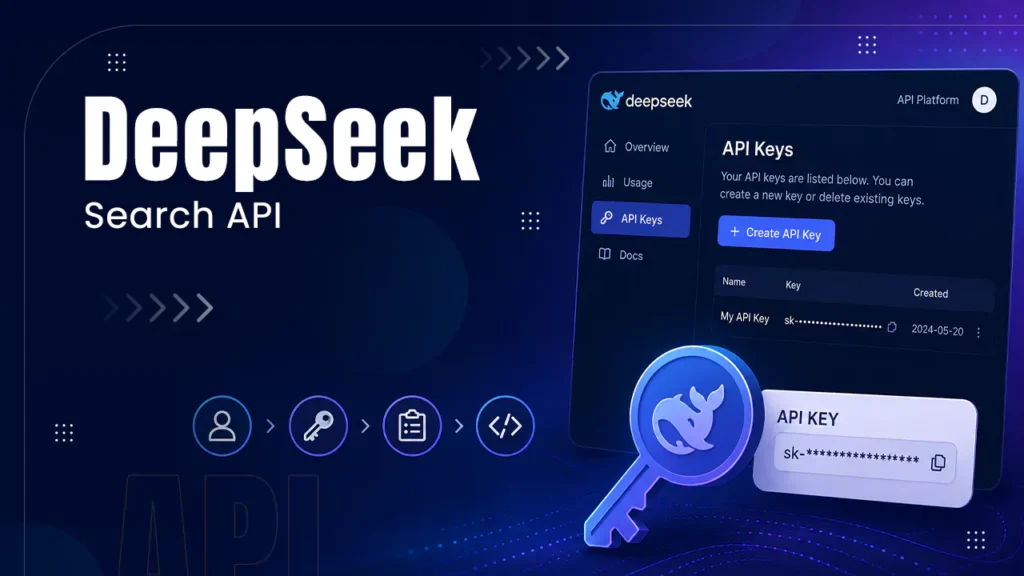
On October 17, 2026, DeepSeek V4.1-Flash-1017 opened its in-house search engine to developers. It shared developer documentation that explains its two web access tools, Search and Fetch API. These are infrastructure tools that let AI agents and chatbots access live web content instead of relying on what models learn in training.
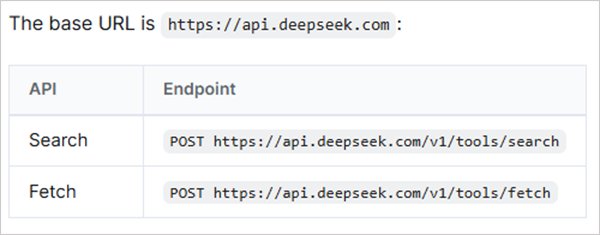
By finding web pages for a query, the DeepSeek Search API returns structured results, and the Fetch API returns its content as Markdown by retrieving a single web page.
What is Explained about its Search Engine
The Chinese AI Lab DeepSeek says the search API can filter GEO manipulation, low-quality content generated with AI tools, and SEO spam. Each result holds a page-level authority tier, and the API generates a 600- to 800-character summary per result.
An explanation of these two tools, with supported operator details and examples, is provided in its Search and Fetch guide.
Web Access API Tools:
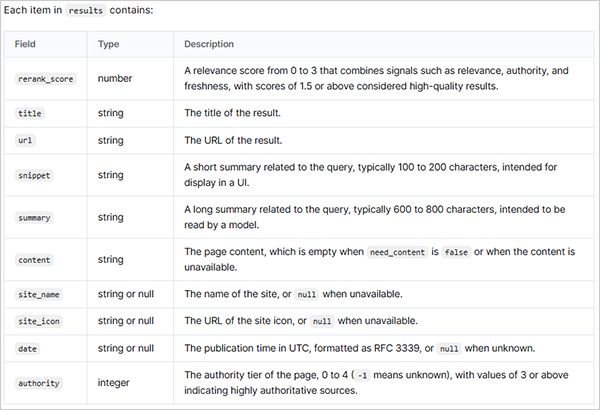
Search API: Search API takes a query and returns a ranked list of web results from DeepSeek’s own in-house search index. Each result includes a title, URL, longer summary (written for models to read), short snippet, publication dates, and two quality scores:
A relevance score (0-3) and an authority tier (0-4).
And it supports operators like site: , lang: , after: , before:, exact match “…” etc.
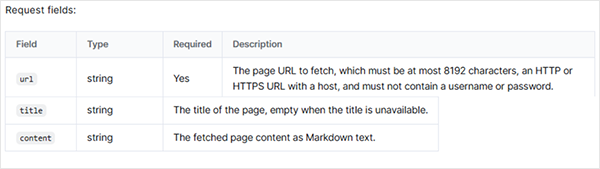
Fetch: The Fetch API takes a single URL and returns the page content as clean Markdown, which is easier for an AI to process than raw HTML. It consumes and strips the page content as Markdown with clean semantic HTML, with proper headings, lists, and tables in a clear structure; also, images that are not in the form of JavaScript are extracted well.
How these API tools are used
This is a retrieval-augmented generation (RAG) pattern, which is a developer application that searches the web, finds the best pages, and feeds the text to the LLM so it can produce a grounded, current answer.
Billing System
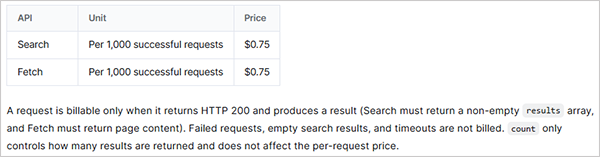
The API’s billed when the request is successful, not by the number of returned results or tokens.
Pricing is 0.75$ per 1000 successful requests for each API, with a rate limit of 100 requests per second for search and 25 for fetch.
Some Tools are Free to Use for Now
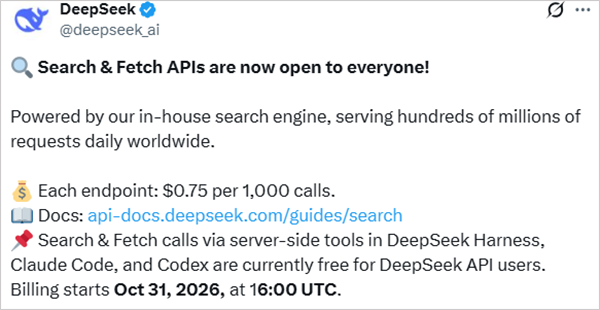
When we use its API through DeepSeek Harness, Codex, Claude Code, server-side tool calls hit the Search and Fetch API. The calls are currently free to us, but billing starts on November 1, 2026, at 00:00 Beijing time, which is October 31, 2026, at 16:00 UTC.
Suggested Read: Google SynthID Detector available worldwide to Check AI-Generated Media.
Where it Matters for SEO
As marketers, we need to pay attention to how it can build its own index and ranking system, so its authority and freshness signals can decide which sites get surfaced to AI agents and get cited in AI answers.
Vinay Kumar, who is a marketer, also shared a view on this.
Final Words
This in-house search engine handles searches on its website, and in one day it can handle hundreds of millions of search requests from around the world, says the DeepSeek changelog.

Leave a Comment
Your email address will not be published. Required fields are marked *