


If a site publishes many useful pages connected to each other to cover a specific topic with unique content, it builds topical authority and shows the site’s expertise and depth of knowledge, which makes it a credible source that readers and search engines love to read.
Topical authority is an SEO concept and not Google’s official ranking factor or score, used to show expertise in one specific topic.
Below are 5 steps to build topic authority so your website can become a credible source.
What is Topical Authority?
Topical authority means the website has not only a single quality page that covers the topic fully but also has many deep and trusted pages that cover all relevant topics with unique content and provide valuable knowledge.
Readers love these kinds of websites to find all relevant topics on a single website.
For example, someone who wants to understand technical SEO can find all related terms like crawling, indexing, and sitemaps on a single website.
And that’s how the website gains readers’ attention, making it a source with many credible pages other sites want to backlink to.
How is it Different from Domain Authority?
Domain authority is not an official term from Google; it is an authority score created by Moz that shows how strong a domain’s links are. There is no official Topical authority score that can be measured; it only describes how well your website covers the topic, but you can track it with signs of progress.
It can also help index your new page faster if it is related to the topic you have topical authority for. Also, a website can have medium domain authority but can have high topical authority.
Why does Topical Authority matter?
A website should focus in some way to build authority, and when a website is made around one topic, it helps find more relevant topics, and each topic supports the others. But building topical authority doesn’t guarantee high ranking; it just builds trust when quality content is created.
Readers: Start with the main question topic and then follow up questions and provide links to other pages.
Search Engines: When a site has relevant pages with a set of queries for the same topic, it’s easier for search engines to understand where the site best fits.
Build Topical Authority in 5 Steps
Step 1: Pick One Core Topic
Choose one topic that is not too broad and not too narrow; for example, pick Technical SEO, not Digital Marketing.
Step 2: Plan a Pillar Page and Clusters
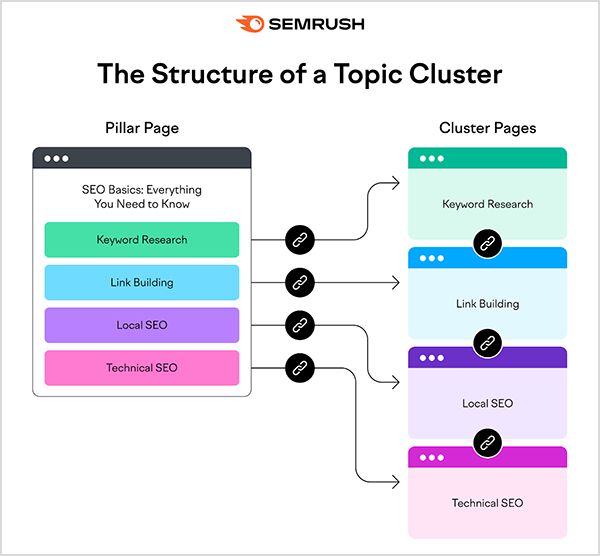
You can start with one pillar page and cover all terms in it; for example, a Technical SEO Guide, and give a full overview of the topic. Then plan cluster posts, for example, XML Sitemaps, crawl budgets, etc and continue covering each subtopic in depth.
Step 3: Match with Search Intent
Search for the topic query you are going to write and see the results on the SERP to understand what type of pages rank guides, tools, or product pages and choose the format that ranks for this query. Topics depend on how the content should be formatted for what the robot.txt reader wants to read, how to use it, and for SEO Tools for beginners, a list of tools with details and pricing is required to cover.
Step 4: Interlink Pages Together
Now start linking the pillar page to every cluster page, and link back from cluster pages to the pillar page and to each other with relevant anchor text to make a strong internal structure. But only link clusters together when the relevance meets.
Step 5: Fill Gaps
Make a list of all your cluster topics in a sheet and check every month to fill the gap if anything is missed or needs to be added. Refresh old posts from cluster pages and add new terms to the pillar page if something is missing or a new update comes.
How to Know the Strategy is Working
There is nothing like a topical authority number in Google Analytics or Search Console. From the Search Console performance report, filter queries by typing them in one by one and compare the last three months.
If impressions for the topics are rising and more queries are now showing, then your strategy is working, and you should keep this.
Mistakes You Can Avoid
There are some mistakes you can make while working on building topical authority; take a look.
- Choosing irrelevant topics makes you unfocused.
- Thin content and content with low word counts just to fill the clusters is not gonna work.
- Missing internal linking after building a cluster page.
- Aiming for the same intent in two posts makes them compete with each other, so make clusters wisely. Understand how to do better keyword research to filter similar topics. (Search learner: keyword research steps).
Final Words
Topical authority starts with choosing one core topic and covering it in depth with high-quality content steadily over time. A small website should begin with a very narrow topic.
It also helps to keep filling gaps, update content across your clusters, and plan the cluster structure before you start internal linking so the links stay organized.



Leave a Comment
Your email address will not be published. Required fields are marked *