

In the past few years, the entire game of SEO content creation has changed, and this transformation is going so fast that keeping pace with it is a challenge.

The most concerning issue here is what’s working for content creation. However, there is no magic to it. Rather, following the fundamentals will work wonders.
Here is a complete step-by-step guide for content creation for SEO to get your posts ranked on search engines and get cited by LLMs.
SEO Content Creation Strategy For Ranking And Citations
Content creation for SEO demands a well-structured procedure and not a reckless approach.
Here are the steps for smart SEO content creation.
- Select Content Type: Content doesn’t always mean blogs or articles. It also includes videos, short-form content like tweets, infographics, or audio like podcasts. Select the type that fits your demands. If your audience wants to have a holistic understanding, like on any mathematical concept, then go with long videos or articles; if they want short and quick solutions, try tweets or reels.
- Design Persona for Audience: Not everyone searching for a product actually wants to buy it. However, the actual buyer has some key problems, demands, necessities, and expectations that the product, service, or information will satisfy. Develop a persona around these key issues to know what they are searching for and what you need to address.
- Search Topic: You can’t put all your knowledge and experience in a single article or video, so try breaking it into topics related to keywords. The keyword is the seed of the content. Select the topics that have traffic, are relevant, and relate to your niche. Try in-depth keyword research for it.
- Intent: The intent for SEO is Informational, Navigational, Commercial, or Transactional, based on why people are making the search. However, Google mentioned 4 different intents, as mentioned below.
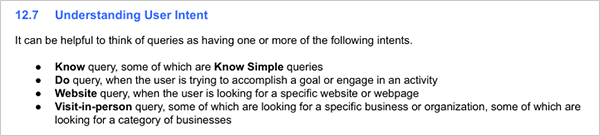
From an SEO’s perspective, intent is essential because if someone came to your site to buy something, but you are flooding them with information, or someone comes for information and you provide them with deals and offers to buy something, that won’t serve the purpose.
Derive the intent of your topic and go accordingly.
- Content Synopsis: Before jumping to start creating content, make an outline of what you are aiming for. Here, deep research and topical analysis matter a lot.
Select the headings, understand perspectives, learn what experts are saying, develop your understanding, and make pointers of what you are going to add in your content.
Matt Diggity has suggested adding a unique factor to the content. He said:
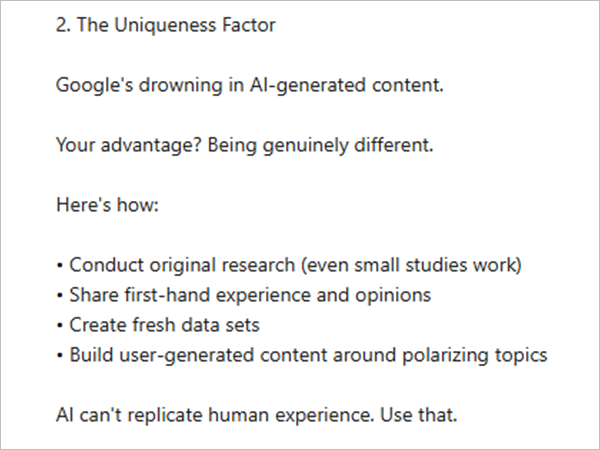
Make sure your content has something that makes it distinct from others, like adding actual photos and genuine reviews, which also raise the authenticity and expertise.
- Drafting: Here the actual SEO content creation works. Use the above skeletonised synopsis to make the actual content. Keep the following points in mind.
- Use the Query Fanout approach to find out what other queries are related to the main query that AI may be searching for and include solutions to those subqueries.
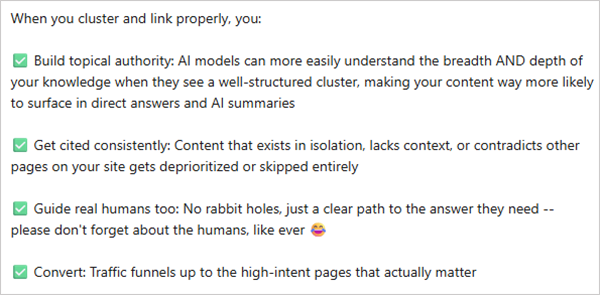
- Make topical clusters about a central theme and try covering as many perspectives as you can. Here, a beneficial piece of advice is not to make lengthy content, be it a post or video, just to expect good ranking. Make content that solves users’ problems irrespective of the length.
Trish Seidel Startsman has suggested some pros of topical clusters in a LinkedIn post, which goes as follows:
- While drafting the content, try adding demos, calculators, scorecards, etc. that will hook users to the post for some time and also demonstrate something unique to them.
- Apply SEO Dynamics: Search engines and LLMs understand content developed in a specific format, which we call SEO, be it on-page SEO, ecommerce SEO, TikTok SEO, or YouTube SEO. Apply relevant SEO practices such as a decent description of your content, good and intriguing headings, and clear formatting to convey to the crawler what the content is about.
- Try AI Repurposing: Your single post can source many other pieces of content. Here are some key suggestions that you can try:
- Make a video out of the blog
- Post a tweet on X about your video or blog
- Make shorts/reels from your video
You can see more such options by checking out our dedicated blog on AI content repurposing.
Suggested Reads: What Are SEO Tools? Simplify SEO with Tried and Tested Tools
Suggestions From SEO Experts
Jan-Willem Bobbink has provided his insights about AI content creation in a LinkedIn post. He said:
“AI made content production 100x faster, but nobody built the infrastructure to maintain what was published. The result is structural debt, and it’s compounding.”
Sam Sami, Founder at BrandClickX, has provided a roadmap for building a topical ecosystem in his LinkedIn post (Mentioned below).
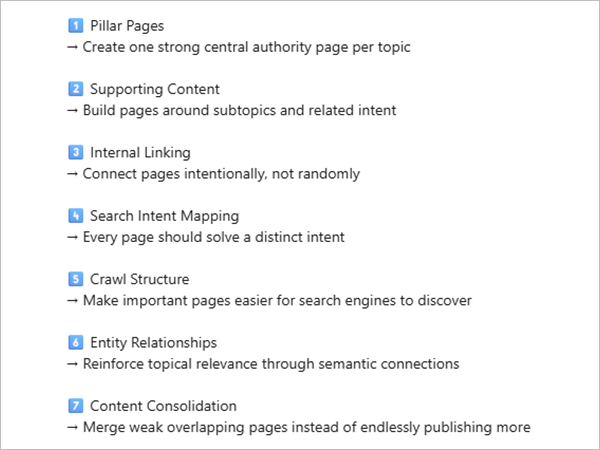
Benji Hyam also extended some suggestions for SEO content creation in his LinkedIn post. His key takeaways are:
- Without subject matter input, writers default to basic “Google research paper” content. Use interviews to inform your writing if you’re not an expert.
- Use specific examples and real scenarios.
- Don’t be afraid to show how your product helps solve the problem.
Way Forward
SEO content strategy is now more of a problem-solving endeavor rather than just stuffing the site to deceive the crawlers. Now Google algorithms have become smarter than ever and are hard to trick to get traffic.
The ultimate mantra is: the content should provide value and must benefit the user.
Next Read: Content Orchestration: How It Works and Its SEO Benefits



Leave a Comment
Your email address will not be published. Required fields are marked *