

AI doesn’t work the same way search engines do. RAG, Chunking, and other strategies make it more complex to approach and realise the results.
Query Fan-out is one such tactic widely used by LLMs but not much considered by digital marketers while designing their strategy.

However, learning and addressing it with simple tweaks will raise your chances of getting cited by LLMs.
What is a Query Fan-out?
Query fan-out is breaking a query into subqueries, answering each one like an individual question, clubbing all those answers, and providing a comprehensive answer to the main query.
Ahrefs defines it as:
“Query fan-out is a technique used by AI search platforms that takes a single user query or prompt and automatically expands it into multiple related sub-queries to generate more comprehensive answers.”
See the infographic below for a better understanding.
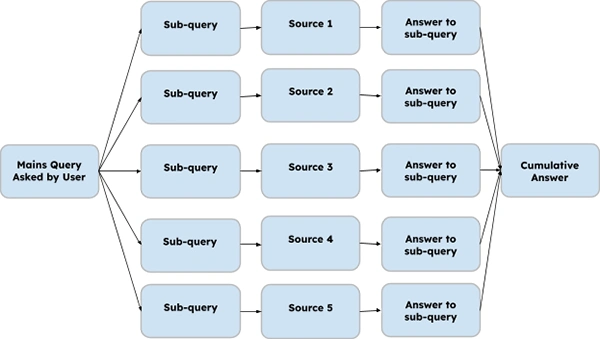
In simple words, it is just dividing users’ queries into parts, extracting answers for those subqueries from different sources, assembling those answer fragments, and presenting them to the user.
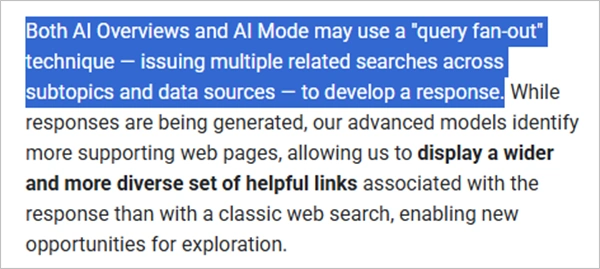
It is not a new word. Rather, Google has explicitly mentioned it in its document and explained it in a few words.
Recently, Reddit’s ChatGPT citation dropped drastically, and analysts have revealed that ChatGPT’s changed query fan-out strategy has led to such quick shifts.
Also Read: AI Citations vs. Brand Mentions: What AI Search Visibility Really Tells You
How to Optimize Content for Query Fan-Out
Query fan-out needs to be handled smartly to hook your content in the LLM’s algorithm.
Go with the AEO strategies such as:
- Headings In Question: The headings and subheadings should be in a query format i.e. having questions about the respective topic.
- Answer In First Line: The first line of the paragraph that follows the heading or subheading must have a clear, crisp, and comprehensive answer to what’s been asked in the heading.
- Tables And Bullet Points: As points are easy to understand and learn and are easily extractable by the LLMs, try presenting your arguments, opinion, recommendations, or any other perspective in point form. Also try making tables when providing comparisons.
- Skimable Content: Highlight, bold, or underline the important lines or words in the content to make it easier to attract readers’ attention.
- Use Stats and Statements: Back your argument with some concrete stats to make it distinct from just an opinion.
Use tools like Answerthepublic, or you can install the ChatGPT Query Fanout extension to learn and get a more refined perspective of the main query.
The “People Also Asked” section in Google Search Engine is also a very productive tool to use. It will give you a much broader view of what people are searching for and will help you find different perspectives on a simple query.
Do competitor analysis, find the keyword gap, see if the missing keywords are relevant for your brand, and if yes, work on them.
Also, do some reverse engineering. Execute the most fundamental queries related to your content, see what perspectives LLMs are covering, find what else is needed to make it a best answer, and add them in your content.
What Digital Marketers Think?
Aleyda Solis has marked query fan-out as a key factor of non-SERP pages appearing on AI citations. See the experts from her post.

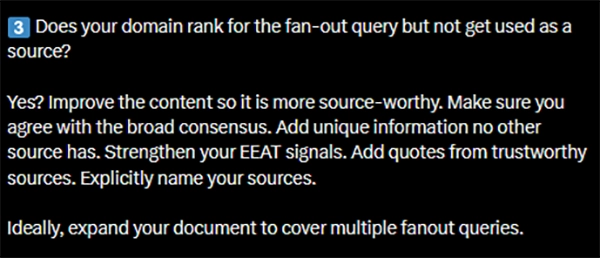
Also, Malte Landwehr, CPO and CMO at Perc AI, has provided a few suggestions to get cited on LLMs, and one of them is addressing the query fan-out requirements.
Hinting at a great development, Chris Long, Co-founder at Nectiv, has speculated about Google Trends integration to fan out query data in his LinkedIn post. He praised the move and also stated:
“If AI search results in fan-out queries, this could very quickly amplify the number of queries reported in these tools. ”
Way Forward
Query fan-out is a part of LLMs’ algorithm and now it needs to be considered while making an SEO strategy. Google claims that its AI features send billions of clicks every week, making query fan-out an even more valuable opportunity for the SEOs to get into those citations.
So now, just writing bulky content, stuffing keywords, and using hypnotic language won’t work. Structure and value of the content have become the key determinants.
Next Read: ChatGPT Ads: Why “Best” and Comparison Queries Matter
Leave a Comment
Your email address will not be published. Required fields are marked *