

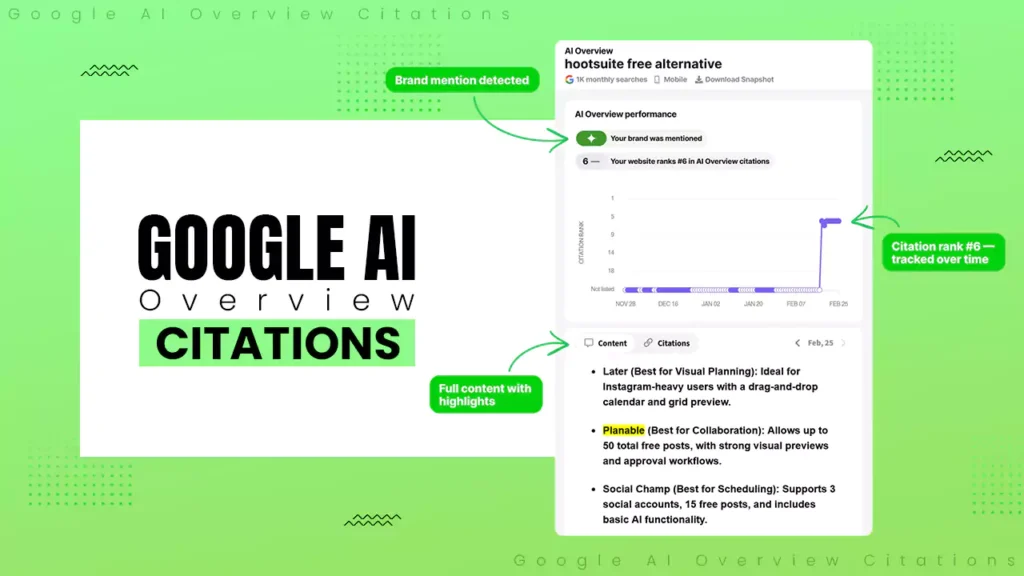
Lily Ray conducted a Google AI Overview citations study and released the inferences in her Substack post titled “Why Calling Yourself the Best Could Be Helping Your Competitors Win in AI Search” in which she concluded that the frequently cited brands posting self-promotional listicles get omitted from the recommended section in 69% of the queries.
It brings some significant conclusions for reorienting the SEO strategies of those utilising self-promotional articles.
The Key Findings on AI Overview Citations
Lily Ray executed 100 B2B search queries with 184 self-promotional listicles and 146 B2B SaaS brands.
Of the 323 self-promotion-cited listicles, 224, i.e., 69.3%, didn’t have these brands in recommendations, hence giving space to competitors’ brands.
She also stated that 74 out of 100 queries she tracked had AI overviews and had self-promotional listicles in citations but didn’t have those cited brands in the recommendations on the search page.
Also, she revealed 3 main consequences that self-promoting brands have been facing. These are:
- Demoting These Websites: Brands using self-promotional tactics are being downgraded in SERP rankings.
- Exclusion From Recommendations: Google is also reducing recommendations for such sites, although it might be seen in the citation.
- Adding A Disclaimer in AI Overviews: A disclaimer for such queries having listicles is being added to the Google AI overviews to help users make a better-informed decision.
She also concluded that:
“Google has at least started to take steps to decouple what it will cite as a source from who it will actually recommend in its AI answers ”
This clearly depicts the crux of the entire study, which is. for self-promoting content:
Citations ≠ Recommendations
It is one of the emerging analyses depicting the undiscovered secrets of AI algorithms. Recent studies related to LLM recall, sudden drop in Reddit citations in ChatGPT, and others have also provided some groundbreaking conclusions.
Suggested Read: Why Does AI Search Prefer Original Research Citations? Possible Gaps and Solutions
How Other Research Explains AI Overview Citations
Itay Malinski also conducted a similar study on self-promotional content and reflected similar inferences as provided by Lily Ray. In his LinkedIn post, he explicitly said:
“Citation is not a recommendation. On Google, an answer that cites your own “best of” listicle is 6.4× more likely to name a competitor than to name you.”
He also cited and supported Lily Ray’s study.

Chris Long also referred to a study conducted by Ahrefs in a LinkedIn post, reiterating its conclusion, i.e.
“In 43% of responses, listicles helped AI source competitors, without mentioning the brand.”
Similarly, Ivan Palii referred to Lily Ray’s newsletter, stating Google penalises self-promoting listicles not because of promoting one’s own brand but due to low effort and AI-generated low-quality content.
Here is the post.
Conclusion
Although it might look like self-promotional listicles are important for AI citation and brand mentions, the Google AI Overview citations study by Lily Ray has affirmed the negative impacts of using such strategies.
Hence, now it doesn’t matter how much a brand boasts about itself. Rather, what matters is the buzz it has created in the market.
Next Read: How to Benchmark Your Brand’s AI Citations Against Competitors
Leave a Comment
Your email address will not be published. Required fields are marked *