

Organic traffic, CTR, and other KPIs won’t work for gauging performance over AI platforms. Then what will?
There is no common answer to it, but deriving one is necessary considering the gradual and swift shift of traffic toward AI agents.
For this, you need to understand how to benchmark AI citations against competitors.
Benchmarking AI citations, in simple words, is measuring the visibility of your brand against competitors on AI platforms.
With increasing engagement with LLMs, it is gaining more prominence than ever.
How To Benchmark Your Brand’s AI Citations?
To benchmark AI citations against competitors, you need to emphasize two major metrics, i.e., share of voice and citation rate. Although many other benchmarks are available, these 2 are easy to learn, measure, and derive inferences about the performance.
Here is a detailed account of these 2 metrics.
Share of Voice
Semrush defines it as
“AI share of voice is how visible your brand is compared to competitors in your market.”
The formula to calculate it is:
Number of times your brand got mentioned on AI / Total number of items all brands in your niche got cited for related queries * 100
Sometimes AI Mentions are considered similar to the share of voice, but it is not. The share of voice means how much you outperform your competitors in citations, and the AI Mention means your brand is mentioned in the answer, irrespective of whether any related page of the brand is cited or not.
Citation Rate
It is the number of times your brand gets cited out of the total number of queries executed.
It is calculated through the formula provided below.
Number of times your brand got cited / Total number of queries executed * 100
Citation is considered important as it depicts the trust of the AI platform in your brand, rather than just another link to refer to for more information.
How it differs from Share of Voice is that while SoV tells if you dominate over your competitors or not, citation rate measures how frequently you are visible on AI platforms.
Suggested read: SEO Is Still Relevant For AI And Will Always Be
How To Measure Benchmark Citations In AI Answers
You can either execute a bunch of related prompts and see how often you and your competitors appear. But performing it over multiple platforms might be a tedious task.
Hence, measuring citations in AI answers requires a dependable AI visibility tool. You can go with any of the following for setting the benchmark.
- Semrush
- Ahrefs
- Profound
- Similarweb
- Otterly.AI (affordable option)
- ZipTie
- Peec AI
Why is Benchmarking Your Brand’s AI Citations Against Competitors Important?
Benchmarking your brand’s AI citations against competitors is essential for various reasons.
Research by iOdigital predicts a 50% drop in organic traffic by 2028 due to shifting interest in AI. This brings AI as an opportunity and a challenge.
We know that organic traffic, keyword rankings, and other metrics are favorable for traditional searches. But AI works differently.
Firstly, Zero-click visibility is a challenge. It is being visible in the citation, but the user won’t click the link after being satisfied with the AI response. This means being visible is the new target rather than being ranked.
Also, AI responses are non-deterministic in nature, meaning that executing the same prompt again and again will produce different results.
Unlike past SEO techniques, the GEO approaches for raising AI visibility work differently, such as having a good review strategy and incorporating crisp and direct answers.
Some minor factors also work. For example, your website translation also has a considerable impact on its AI visibility.
You will be surprised to know that the AI citation process also varies among the LLMs. Even Google AI mode and AI overviews follow different criteria, as mentioned by Geertrui Laleman, Senior AI Search Optimization Manager at Semrush.
This has also been reiterated by Arun Pandit, Founder of Visiby, who explicitly mentioned that the citations of different AI platforms overlap partially. See what he said.

All these factors cumulatively impact the complexity in benchmarking the brand’s AI citations.
The word of SEO and GEO Experts
Neil Patel, one of the top digital marketers, is of the view that:
“AI search visibility is not just a traffic game. It’s a reputation game.”
Also, he affirmed that fresh content can help with AI citations, but not to a very high level.
AI citations are highly influenced by the brand authority, as said by Linda Zebian, VP Communications at Muck Rack, in her blog.
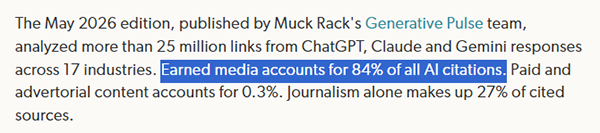
Hence, focusing on the brand rapport has come up as a sine qua non for being in the AI citations.
Sum up
There is no specific and exact metric or coefficient to answer how to benchmark your brand’s AI citations against competitors. All you need is to follow the citation rate and share of view, measure where you stand, improve your strategy, and get more visibility. But first, improve content quality before targeting citations.
Next Read: Evergreen Content or Trending Themes for SEO. Which One to Choose?
Leave a Comment
Your email address will not be published. Required fields are marked *