


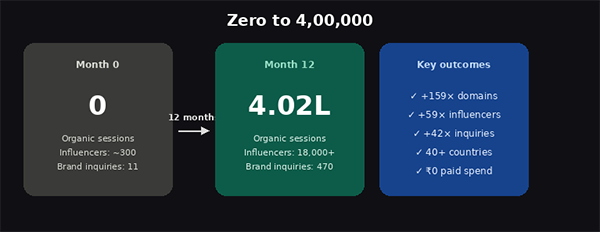
Zero to 4,00,000 organic sessions. 18,000+ influencers onboarded. ₹0 in paid acquisition.
Upon taking the InfluencersPlace project, I recognized it as a “classic” example of a “cold start problem,” which is an issue all marketplaces have. InfluencersPlace was in a brand-new vertical (domain). The website didn’t have any backlinks. There wasn’t any organic search volume on the site. More importantly, it had zero registered influencers and zero registered brands on the platform.
Marketplaces always sit between two parts of the supply and demand chain that cannot be moved independently. Brands will not join a platform if the available influencer base is low. Conversely, influencers will not sign up to platforms with little or no work. The cost associated with paid advertising did not solve either of these problems from a business perspective. A click would generate one registrant, and when that money was gone, the growth of the platform ceased.
However, I saw this differently.
The Insight: Search Demand Already Exists — Own It
In order to avoid developing demand where there isn’t any demand, I instead decided to pursue existing demand that is constantly being searched for every day. My research has shown that thousands of individuals are searching for individual influencers by name each month.
Each month, the exact same name-specific search terms appear on Google (i.e., Salish Matter, Joe Bartolozzi, FGTeeV Chase, etc.); these aren’t searches for awareness of a particular brand. Rather, they are highly intended search requests from enthusiasts, writers, managers, and brands who have a very specific need: a bio, rate card, number of followers, contact handle(s), past work history, and current projects.
There is obviously an enormous amount of search demand here. However, this demand is also currently going unmet. Rather than competing as part of the broad “influencer marketing” or “influencer platform” space, which are phrases that will likely require many months/years to begin ranking for but will likely never be converting customers either. I created a list of 12,000+ searches that can be organized into four clearly defined search intents.
- Influencers pricing themselves (individual creator searches)
- Influencers looking for campaigns
- Brands looking for influencer lists (by niche, location, rate)
- Brands comparing agencies (competitive research)
Each intent would get its own page template. This became the foundation of the strategy that would be executed with my team.
The Bet: If I could rank for both supply-side searches (influencers searching for themselves) and demand-side searches (brands searching for influencer lists) on the same domain, the marketplace could attract both groups and grow on its own.
Phase 1: Demand Map Before a Single Page (Month 1)
Before I published content, I took the initial month to map my intent and create templates.
I grouped these 12,000 searches into 4 separate page structures (each having a unique search intent). Instead of creating blog-style posts, I created a specific template for each of the 4, focusing on one internal linking path from supply to demand. This ensured no cannibalization existed among these pages. There were no competing pages vying for the same keywords.
Results:
- Designed 4 page types
- Built 1 internal-linking structure
- Eliminated all keyword cannibalization
The template-based design meant that when new pages went live, they worked together, reinforcing each other rather than competing. Each influencer profile is linked to their respective niche pages. Each niche page linked to its respective city page. And each city page linked to the editorial hub. It wasn’t by accident; it was intentional.
Phase 2: Programmatic Pages With Real Supply Data (Months 2–4)
With the templates locked, I could generate huge amounts of pages, but only if they contained true, useful information.
I used the InfluencersPlace Roster Database to create automated pages by using the three dimensions:
Platform × Niche × City
Each page contained real data: how many gaming influencers are in Mumbai with 100k + followers, what is typical pricing for this type of influencer, examples of creators who are currently working within that space, and a contact form for brands.
Thin pages were left out completely. If a platform-niche-city combination did not have actual supply to pull from, then I would not generate a page on it. This allowed us to do clean indexations without the influence of poor-quality thin content affecting the quality score.
Results:
- 2800 total pages indexed
- Indexation success ratio = 91%
- All pages included queryable data
It wasn’t until month four that all the necessary components of InfluencersPlace infrastructure was in place. It hadn’t received much traffic, yet it was still in the middle of the indexation and testing phases of the template quality assurance process. However, its foundation was established.
Phase 3: An Editorial Hub That Earned Links (Months 3–8)
While the programmatic pages were being indexed, the site needed credibility as an authority. Journalists and influencer marketing agencies searched for benchmarking articles or contract templates. None of these types of items were located anywhere on the web in a structured format. I made them.
On the editorial hub I produced:
- Benchmarking rates for each social media niche and platform (influencers needed this information; brands needed it too)
- Studies comparing the payouts received by creators across various industries
- Standardized template contracts for creators
Not every post was about creating “SEO” content. The posts were valuable enough to be referenced in journalist and creator newsletters. Each resource was carefully placed so they could help advance the company’s primary objective while still providing value.
Results:
- 640 referring domain links
- None were paid for link placements
- Each link was natural and occurred simply because the content provided a solution to a real issue facing users.
This is when the compounding effect begins. Authority began flowing from the top of the editorial hub down through all of its internal linking. Now the programmatic pages, which previously had no topical signals behind them, had both authority and topical signals behind them.
Phase 4: Technical Debt Paid Weekly, Not Quarterly (Ongoing)
During this time of increasing volume on the site, I went about optimizing the technical aspects of search engine optimization in a systematic way, not just as an audit; I did it as an ongoing process.
I performed the following every single week:
- Optimized Crawl Budget (removing pages that were below the impression threshold)
- Maintained Core Web Vitals (maintaining LCP < 2 sec; CLS & FID targets met)
- Validated Schema for Creator Profiles (valid markup 100%)
- Enforced Indexing Rules (merged/removed all pages that were below the impression floor)
After twelve months, the site was down to one-third of its original size due to removing weak pages and creating less bloat through additional content. This was beneficial in maintaining quality.
Results:
- The average LCP was under 2 seconds.
- Valid profile schema 100%
- No wasted crawl budget
Phase 5: Search Traffic Wired to Onboarding (Months 5–12)
By month five, both the programmatic layer and editorial hub were being ranked at the same time. The traffic came, but traffic itself is not the ultimate objective. Conversion is.
All of the rank pages led to one of two doors for users.
- For Influencers: “Claim This Profile” → Creator Registration
- For Brands: “Find These Creators” → Brand Inquiry Form
The conversion funnel was created as part of the Influencers Place pipeline. To us, traffic is not just another vanity metric. It’s an additional demand generation channel.
The Growth Curve: How Compounding Played Out
Here’s what the 12-month growth trajectory looked like:
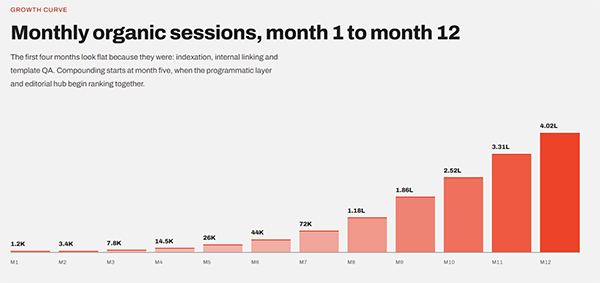
| Month | Organic Sessions | Notes |
| M1 | 1.2K | Indexation phase |
| M2 | 3.4K | QA and template refinement |
| M3 | 7.8K | Editorial hub launches |
| M4 | 14.5K | Programmatic + authority begin ranking together |
| M5 | 26K | Compounding begins |
| M6 | 44K | More influencers onboard, more profiles published |
| M7 | 72K | Network effect accelerates |
| M8 | 1.18L | Authority signals flowing through spine |
| M9 | 1.86L | Flywheel established |
| M10 | 2.52L | Organic growth compounds monthly |
| M11 | 3.31L | Influencers recruiting influencers through search |
| M12 | 4.02L | 400K annual sessions |
The first four months were set up. Months 5–12 were compounding growth, where each new influencer added both supply and rankable content simultaneously.
Suggested Read: How Long Does SEO Take in 2026? Factors Affecting Results
The Results: Before and After, Twelve Months Apart
| Metric | Month 0 | Month 12 | Change |
| Annual organic sessions | 0 | 4,02,000 | 0 → 4L |
| Ranking keywords | 0 | 31,400 | New |
| Top 3 positions | 0 | 1,860 | New |
| Referring domains | 4 | 640 | +159x |
| Influencers on roster | ~300 | 18,000+ | +59x |
| Brand enquiries/month | 11 | 470 | +42x |
| Paid acquisition spend | – | ₹0 | Unchanged |
The platform went from 300 influencers to 18,000+. Brand enquiries went from 11/month to 470/month. And the entire growth engine ran on organic search, zero ad spend.
Why This Worked: The Three Principles
1. SEO Should Solve a Business Problem, Not Just Drive Traffic
Most search engine optimization techniques optimize for traffic & rankings. I optimized for influencer onboarding. All the tactics, keyword Research, page structure, internal linking, and even technical clean-up served one singular goal: getting influencers and brands to the platform.
The aim was 100,000 sessions within 12 months. I achieved 400,000 sessions. More importantly, however, the conversions came as these sessions were high-intent, searchers actively seeking exactly what InfluencersPlace provided.
2. Marketplace Growth Comes From Network Effects, Not Individual Page Optimization
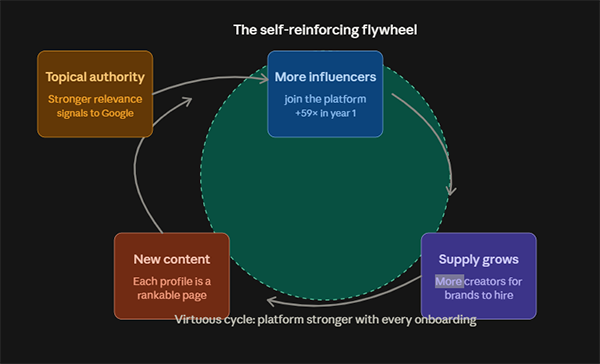
Kevin Indig, an experienced growth strategist, also notes in his writing about marketplace SEO that growth in two-sided markets occurs based upon how many other users are using the platform, not through the optimization of individual pages. Each time a new influencer was onboarded at InfluencersPlace, it performed three functions at once:
- Added supply (increasing the number of creators available for brands to select from)
- Generated indexable content (creating a new profile page that would be relevant to branded search queries related to the creator’s niche)
- Increased topical authority (the amount of data available within the niche represented by the influencer)
Therefore, each time a new influencer was onboarded at InfluencersPlace, it made the platform stronger. This created a virtuous cycle around SEO, rather than creating content manually.
3. Target Existing Demand, Not Creation of Demand
I didn’t try to rank for “influencer marketing platform.” Those terms have massive volume but take years to own, demand conversion optimization, and require massive brand spend to convert.
Instead, I targeted terms where demand already existed: individual influencer names, niche-based searches, and city-based talent searches. These converted faster because they were specific. A brand searching “Gaming influencers in Mumbai” is further along the buying journey than someone searching “influencer marketing.”
What Brands Saw
As the platform gained momentum, brands began to take notice. It was no longer just an available pool of talent; you could find thousands of active influencers at your fingertips. It became a real resource.
Brands from over 40 different countries were sending us inquiries about using the platform. A few actually did sign contracts with some of the individual creators. Many others used the platform as their primary way of booking influencer campaigns.
What I Learned: The Bigger Picture
This project provided evidence for something that leading voices in search engine optimization (SEO) have said for years, yet many companies fail to utilize this method:
SEO is about solving whatever problem your business has.
- If you are a B2B SaaS company, then SEO should generate qualified leads and not simply provide random visitors.
- If you operate an online marketplace, then SEO should create both the supply and demand at the same time.
- If you maintain an online directory, then SEO should deliver the correct type of users to the correct entry point within the directory.
In general, there is no question as to why most Search Engine Optimization (SEO) professionals use visitor traffic and ranking metrics when measuring their success; it is because they focus on vanity metrics rather than measuring how well their efforts align with the goals of their businesses.
From day one of developing the marketing strategy of InfluencersPlace, the goal was clearly defined: More visitors was not the ultimate objective. The right visitors. Those that will ultimately convert into customers.
With an attention-to-detail approach and the ability to execute technically precise implementations, I was able to ensure that traffic not only came to us but also converted.
The Takeaway for Any Business
Using traffic and rankings as the only indicators of success for SEO is no longer a viable option. Instead, ask yourself this question:
What are your business needs? It’s fundamental to analyze your market segment before making any decisions about SEO.
- For marketplaces, is your need for supply or demand, or both?
- For SaaS, are you focused on generating leads within a specific industry, market segment, or ideal customer profile?
- For directories, do you require the attraction of users who are most likely to convert?
- For service-based businesses, do you want to attract high-intent searches?
- Once you understand what your business requires, you can utilize SEO for that specific purpose and stop thinking of it as a general marketing channel. SEO becomes a tool to solve problems.
Through my experience with InfluencersPlace, I learned that my best growth tactic was using the Internet to help potential customers find us rather than down the costly route of advertising.
I discovered that the majority of the traffic was already taking place through Google searches on an everyday basis. All I had to do was develop the right content using the correct keywords and set up the conversion funnel to close the loop.
This resulted in over four million sessions, 18,000 creators, and more than 40 countries, all with no budget spent on ads.
SEO became more than just for traffic generation; it transformed into an efficient acquisition tool.
Next Read: Evergreen vs Trending Content: What Should You Publish?
Leave a Comment
Your email address will not be published. Required fields are marked *