

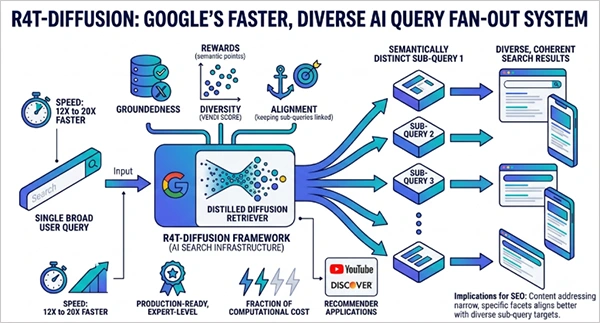
Google released a research paper and introduced the R4T-Diffusion (Retrieve-for-Train Diffusion) Technique, which is a framework designed to make query fan-out systems faster. Google introduced this new update on 15 September 2026: R4T-Diffusion, which is faster than Query Fan-Out, and presented at ICML 2026: “Efficient, Property-Aligned Fan-Out Retrieval via RL-Compiled Diffusion”. In this research paper, there is an explanation that R4T is a three-stage AI framework designed to generate fast and low-cost results.
This is a test currently rolling out, and the Google research team is working on it; the research paper was released months ago before the announcement.
What is R4T-Diffusion
R4T is based on a diffusion-based retriever, which is used in the Google retrieve-for-training frameworks. R4T-Diffusion starts with value retrieval when a search system needs to return a useful collection of complementary results and also not make many versions with the same result.
Google analyzes and understands the problem which can be optimized in AI-powered query fan-out techniques because large language models require more time for computation for multiple subqueries.
This generates multiple retrieval directions in parallel and does not generate text subqueries one at a time.
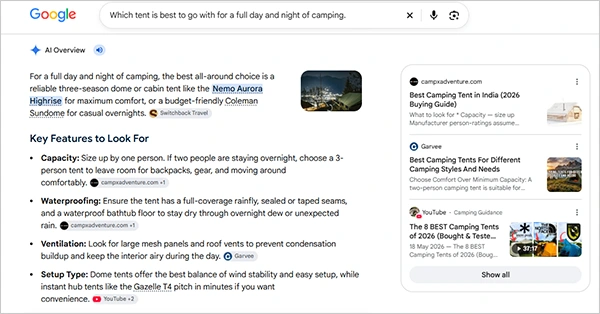
If someone searches for camping gear, a useful retrieval system covers the user’s requirements, such as a tent, a sleeping bag, an electric stove, etc. It does not provide results only for various types of tents.
What is Query Fan-Out
In the Query Fan-Out technique, a single broad search query gets broken into multiple related subqueries so it can cover different parts of the user’s search intent.
This mechanism works to provide a single search term to find nearly identical matches and provide results for all those terms, rather than only providing results for the same search term.
Suppose someone searches for a bohemian festival style; they can have different needs like boots, lace, etc which match with these styles.
Google R4T-Diffusion is Better than Query Fan-Out
Query fan-out is working better, but the only problem is that teaching an LLM to extract and think through the decomposition process is taking time and is also expensive.
It is trained to identify user aspects, identify relevant queries, and reduce synonyms.
How R4T-Diffusion Works
In a traditional system, it generates text subqueries; now the R4T diffusion system is optimized for set-level rewards and provides output all at once.
This diffusion-based retriever uses a three-step process:
Step 1: Train a Fan-Out LLM: Using reinforcement learning, Google trains a fan-out language model that is optimized for properties including diversity, query alignment, and database groundedness.
Step 2. Create Training data: Now it is a requirement to train data, and the challenge was to keep these directions diverse, relevant, and grounded in the available database.
Step 3. Train the Diffusion Retriever: From the data, the diffusion retriever is trained for small queries. It works with a core optimization goal.
R4T Generates Multiple Queries
Google’s research retrieve-for-train generates multiple queries using a three-stage pipeline:
- Reinforcement
- Learning
- Lightweight diffusion model
The result is strict and fulfills the user intent and does not provide a very different result.
Ignore all synonyms repeatedly used in any information that provides the same value and force analysis of real results.
Improved Search Response Time
This R4T Diffusion framework is just a modified upgrade to query fan-out techniques so the thinking cost and time can be reduced.
R4T does not use subqueries sequentially but uses a tiny 53.9 million-parameter model to generate a single parallel pass.
It improves speed and delivers results 12 to 20 times faster and scales linearly, taking 50 seconds under large content batches.
More Advanced AI-Powered Search Experience
The new Diffusion system can also include recommendations from Google Discover and YouTube and provide an advanced search experience to users.
The results provide various data, from extracting details from a set of data to providing the next search results in the same query result.
There is a new update also released from Google for Reducing Spam with the September Spam Update.
What Experts Say on this New Update
Roger Montti has posted on LinkedIn and says the new query fan-out system is faster, cheaper, and production-ready for search.
Search Engine Journal also explains in their article how these query fan-out results are higher quality, faster, and less expensive, and provide results beyond searches.
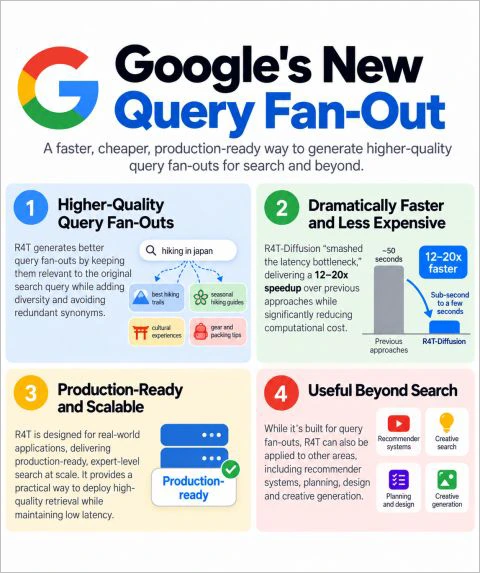
Dan Petrovic shared a visual also clearly shows how this faster fan-out is working and trained, and explains fan-out vectors.
Next Read: Google Search Profile Update
Conclusion: Google Shift Toward Faster Query Processing
In this query decomposition process, complex queries break into subqueries, which are easily manageable and provide some logical key points in the results. The narrower the query intent, the faster and better the results are.


Leave a Comment
Your email address will not be published. Required fields are marked *