

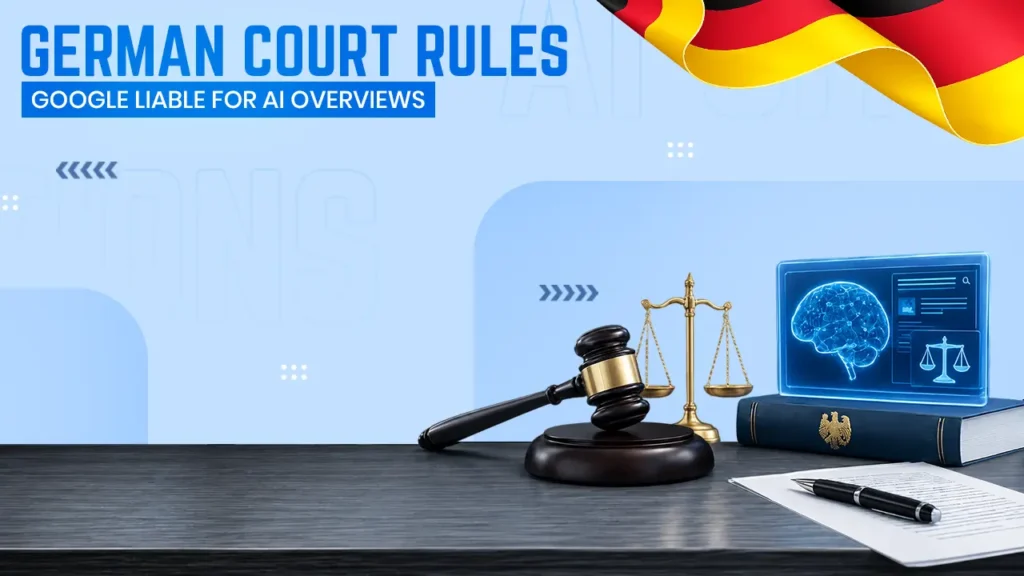
Recently, the Regional Court of Munich has made Google directly liable for the AI overviews it shows on the search pages. This has triggered a worldwide discussion over their reliability when AI responses and outputs are being trusted and used recklessly.
In another dramatic response, the US government lifted the ban on Anthropic’s latest models, Fable 5 and Mythos 5, that got banned following national security concerns, which has again cast doubts on the ethicality and dependability of AI.
What is The Case?
In case number 26 O 869/26, the plaintiff has questioned Google’s AI overviews and held Google responsible for the AI summaries it provides in the search.
The court has clearly said that the AI content is Google’s own content, as Google solely has the operational dominance and authority over the AI overviews, and merely citing the resources won’t absolve it from referring to wrong information.
How Reliable Is The AI Overview And Citations?
Last year, Columbia Journalism Review released a paper revealing that AI citations have no guarantee of accuracy. Earlier this year, Northwestern University also demonstrated how AI responses can vary from actual facts.
Even Sunder Pichai, the CEO of Alphabet and Google, has said on a live podcast that the AI overviews are more opinionated and require improvements.
The AI systems use RAG, i.e., Retrieval-Augmented Generation, through which they incorporate new information from external data sources. Although it is considered highly accurate, the concept of RAG Poisoning has cropped up, where AI systems can retrieve misleading information.
In this context, Anthropic, the parent company of Claude, is also of the firm view that a small number of samples can poison LLMs of any size, which demands attention from the global communities relying on AI citations.
What is Google’s Response?
Although the spam and manipulative techniques are constantly interfering with AI overview and citations, Google has been adopting and evolving to challenge the threats in its one way, as mentioned in its official blog named “How we’re combatting AI scams with security, legislation and more”.
Google has also released a document in May this year titled “Optimizing your website for generative AI features on Google Search,” explicitly mentioning that any practice of manipulation in generative AI responses will be considered a violation of spam policy and will attract suitable action.
Further, Google has released 2 core updates and 2 spam updates this year till now, which might be a revision in their approaches, especially concerned with AI overviews and citations.
Bottom line
AI is still in its formative stage and is not to be relied on blindly. Whenever you find the Google AI overview false, not productive at all, or not addressing the core issue, then just go to the end of the overview and press the thumbs down button, i.e., the Bad Response button. This will help Google to refine the analysis and will help it come up with better answers.

Further, always cross-check the information you see on the overviews by visiting the genuine official websites or dependable sources.
Leave a Comment
Your email address will not be published. Required fields are marked *