


In January this year, a blog titled “The AI platform shift and the opportunity ahead for retail” by Google’s CEO Sundar Pichai mentions that Google is partnering with retailers to help them adapt to the gradual shifts occurring due to AI.
It was one of the stepping stones to further simplify the shopping experience of users, since the inception of generative AI and the release of different protocols supporting it.
These are the ripple effects of the genesis of agentic commerce and the development of ACP and UCP by the AI agents.
Agentic Commerce Protocol (ACP) by ChatGPT
Agentic Commerce Protocol is ChatGPT’s protocol that serves as a communication channel to link people, AI agents like ChatGPT, and merchants to allow people to search for products and make payments through AI agents.
It was developed by ChatGPT Stripe in partnership with leading merchants.
Here, the most crucial part that people feel apprehensive about is making payments.
OpenAI has clarified how it happens.
It says the payments are handled by the merchants using their existing systems, where ChatGPT provides a communication funnel between the customer and the merchant. The merchants have to pay a small platform fee, but it is completely free for the users.
It happens as shown in the diagram below, showing how components work as links in the chain.

Suggested Read: Google AI Search Optimization Guide: Strategies to Improve Visibility
Universal Commerce Protocol (UCP) by Google
Universal Commerce Protocol is an open-source standard that acts as a medium or common language between merchants and AI platforms like ChatGPT and Gemini. This protocol was developed by Google and other partners like Shopify, Target, Visa, and Mastercard.
Here is a simple illustration of how it works.
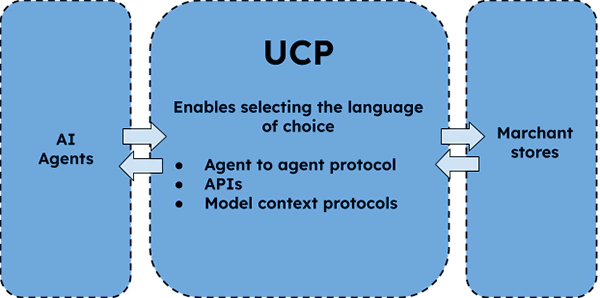
This protocol works for order management, identity linking, product discovery, checkout, and managing the product cart, thus simplifying the shopping experience supported by AI assistance.
Philipp Schindler, Chief Business Officer at Google, has clearly mentioned that UCP is setting standards for agentic shopping while discussing the AI investments.
Future of AI Shopping
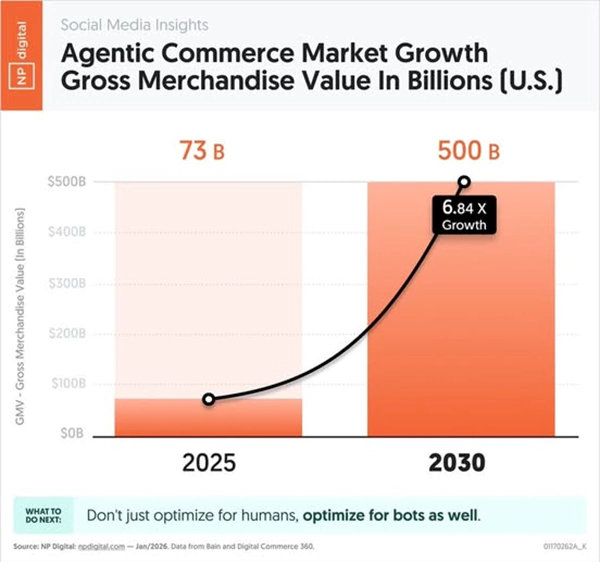
The stats show a 6x increase in agentic market growth as observed in the picture below.
Salesforce has revealed that they drove sales worth $67 billion, of which 20% were influenced by AI and agents.

In the same perspective, indicating the prospects of UCP, Google’s Vidhya Srinivasan said;
“UCP’s potential extends far beyond retail. It’s helping to lay the foundation for a future where all commercial experiences can be seamless and agentic.”
As AI agents have been raising the frequency of ads in conversations, like ⅓ of queries on Google AI mode have ads, the upsizing of the purchase volume can be expected in the near future.
In May this year, Google introduced Universal Cart, which allows users to add items to buy for different merchants while simultaneously searching, using Gemini, watching YouTube videos, or working on Gmail.
All these indicates toward transforming the purchases into “smart shopping”
The Words of Digital Marketers
The digital marketing community has suggested adapting to the new situation and focusing on increasing visibility over the AI agents.
Here, Malte Landwehr, CPO and CMO of Peec AI, has revealed that the shopping widgets in ChatGPT are powered by Google Shopping, which opened new floodgates for discussions.
Also, after experiencing the UCP-powered checkout, Brodie Clark, a renewed SEO expert, is of the view that new tools and features will be added to Google Merchant Center in the near future.
In a podcast with Chris Hall, Harley Finkelstein, President of Shopify, has said that agentic commerce is giving thrust to merit-based sales, where the features and value of the product win over mere traffic-attracting sales items.
Concluding Remarks
Agentic AI is not the future; it is the present. This marks a shift in SEO strategies from targeting Google search to validating the presence on AI platforms to raise sales. This demands prompt and smarter responses like updating the Google Business Profile and reconsidering review strategy to become more visible on AI.
Next Read: Google Tightens Disclosure Rules For Ads

Leave a Comment
Your email address will not be published. Required fields are marked *