

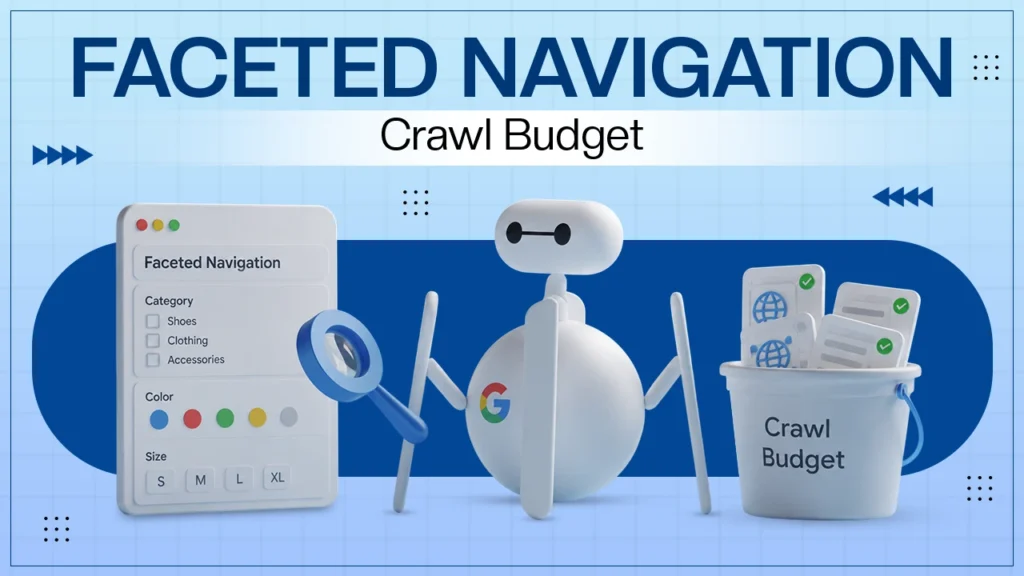
A big site with multiple pages handles a large business. This brings more sales and profits, but simultaneously requires some distinct approaches to stand out.
The most daunting challenges in maintaining the efficiency of these sites are faceted navigation and crawl budgets, which, if neglected, might impair the website’s performance.
Hence, both these require extensive technical SEO fixes to keep the site alive and kicking.
What Is Faceted Navigation And Crawl Budget?
In simple terms, Faceted Navigation refers to exhibiting only the part of the website to the user that they demand. This is done by using certain filters on the page.
Ahrefs defines it as:
“A UX pattern that helps users find specific listings on category/archive pages by allowing them to filter based on various attributes that the listings have.”
Let’s take an example. You visit an e-commerce site to buy shoes. But it has numerous options on the deck.
To save time and effort, you would simply apply multiple filters like shoes for men, size -8, canvas shoes, back color, etc to get what you want. This is faceted navigation.
On the other hand, Crawl budget means the number of pages Google crawls in a specific timeframe.
In a document titled “Optimize Your Crawl Budget”, Google explained it as
“There are limits to how much time and resources Google can devote to crawling any single site. The allocation of these resources is commonly called a site’s crawl budget.”
Crawl budget doesn’t significantly impact small websites, but is really an important factor for websites with a large number of pages and which get updated more often, such as e-commerce sites or NEWS sites.
The simple math is if,
Number of Pages > Crawl Budget
⇩
Then some of your images won’t get indexed.
Both of these became far more vital with the release of Agentic Commerce Protocols by AI agents.
Suggested Read: Google Page Indexing Report Update: What Changed in Search Console?
How to Optimize Faceted Navigation?
Faceted navigation is a problem for large websites and can generate an infinite number of URLs, which might negatively impact the website.
See how it might impact.

It has been reiterated by Aleyda Solis, a popular SEO and AI search Consultant, who said:
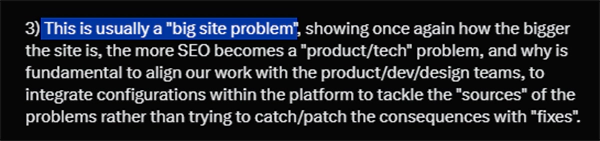
This can cause an endless loop of the same pages on a website.
Thus, it is a convenience for the users but a potential SEO snag for the website owner (if not addressed).
Google suggests some fundamental remedies for this.
- Block the faceted navigation URLs through robots.txt or use URL filters (#) for it.
- Optimize faceted navigation URLs by
- Using the & operator for such URLs
- redirecting empty results to a generic “not found” page only in an emergency and not as a normal function.
- In case a filter combination has no results, return it to a 404 status code.
- The URL paths have a consistent order of filters.
Other suggested solutions for it are:
- Set canonical tags for the respective pages
Ex. URL with issue:
website.com/prductcategory/productlist?filter_color=black&filter_size=20
Canonical URL:
website.com/prductcategory/productlist
- Block crawl through robots.txt. But be cautious of it. Opt it only when you know how links are flowing through your site.
How to Optimize Crawl Budget?
Firstly, we need to understand what drives the crawl budget.
A website with higher authority gets more attention from the Google crawler, which influences the crawl budget.
If the website is new or not performing well, its authority will be below the benchmark, and it will have a low crawl budget.
Some fundamental steps to raise it are:
- Page speed should be fast.
- Navigation should be clear.
- Rectify page errors (if any).
- Revisit the link hierarchy/structure. Prioritize important pages at the top of the hierarchy.
- Dispose of or replace spammy or low-quality content.
Another point to consider here is the crawl limit, which determines how many pages can be crawled in parallel. This depends on your hosting.
So,
| Better Hosting ⇒ High Crawl Limit ⇒ More Crawl Budget |
Also, the crawl demand impacts the crawl budget. When you add new, updated, and productive content on the site, the demand for your site to get crawled increases, and this proportionally impacts the crawl limit.
Some additional suggestions to get it done are:
- Check and rectify the broken links.
- Reduce heavy redirections on the website.
- Use HTML in pages to make it crawl-friendly. (Use Java only when required)
When faceted navigation creates too many unnecessary URLs, Google may spend more crawl resources on those pages instead of your important content.
Optimising these URLs helps improve crawl efficiency and ensures that high-value pages are crawled more consistently.
The POV of SEO Community
Considering faceted navigation, Neil Patel, a digital marketing expert and founder of NP Digital, has explicitly mentioned its pros and cons for a better understanding.
| Pros | Cons |
| 1. Saves time | 1. Triggers content duplication |
| 2. Raises conversions | 2. Wastes crawl budget |
| 3. Simplifies navigating large websites | 3. Decreases link equity |
| 4. Supports SEO |
This makes it an opportunity and a struggle at the same time.
Also, Peter Rota, an On-Page SEO Specialist, has provided a few workable solutions for addressing the crawl budget issue.
Here is what he says.
Way Forward
Both faceted navigation and crawl budget are interlinked and require strong adherence to technical SEO. As both of these are more concerned with big sites with multiple pages, small site owners need not bother about them.
All the above-mentioned strategies are not just to make them appear on the search results, but also an undeniable part of AI search and LLM optimization strategies.
Next Read: Google Rolls Out Top Stories Carousel in AI Overviews: What Publishers Need to Know
Leave a Comment
Your email address will not be published. Required fields are marked *