

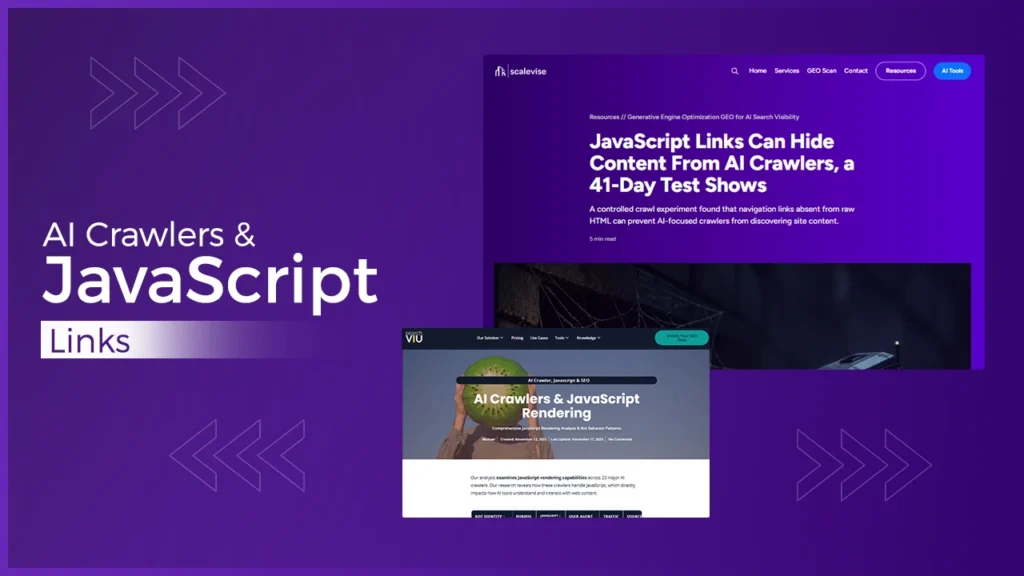
A recent test conducted by SEO engineer Vinicius Stanula was published on Scalevise, titled “JavaScript Links Can Hide Content From AI Crawlers, a 41-Day Test Shows” which showed crawlers’ response to JavaScript links.
In simple words, the study differentiated how HTML links and JavaScript links get discovered by Google crawlers and AI bots.

The conclusions provided in this AI crawlers JavaScript links test extend a wealth of productive suggestions for technical SEOs to make sites more AI-friendly.
What the Study Reveals About AI Crawlers and JavaScript Links
The AI crawlers JavaScript links study spanned 41 days, analysing 30,180 requests across 27 different crawlers.
Across the 21 top-level category pages, 11 categories relied on HTML links while the remaining 10 considered client-side JavaScript for internal links.
The inferences of the study are very interesting.
The AI crawlers didn’t discover any JavaScript-only links, while search engines reacted but with depth-limited coverage, i.e., discoverability reduced at deeper levels.
When these links turned to HTML, GPTBot and BingBot discovered 250 and 89 new pages, while Google added none.
Vinicius Stanula stated that different crawlers have different efficiencies, and considering that all bots work like Googlebot might hamper the website crawlability for LLMs.
He has also added a productive suggestion to counter such hassles, which is:
“Server-rendered HTML, static generation, or other approaches that expose anchors in the initial response can preserve a JavaScript-enhanced experience while giving crawlers usable navigation.”
Also Read: Faceted Navigation and Crawl Budget: The Technical SEO Fix Most Sites Get Wrong
Broader View at AI crawlers JavaScript Issue
Last year, SearchViu conducted research and came to the conclusion that 69% of AI crawlers can’t execute JavaScript, causing missing dynamic content like product listings, user-generated data, and real-time updates.
The fact is, simple Google has learnt to render JavaScript, but AI hasn’t yet. Googlebot is executing JavaScript at a good level, but this is not the case with LLMs.
It also raised a critical infrastructural gap where web development has shifted to JavaScript because Google has learned to handle it.
The core issue revolves around the fact that the LLMs don’t render the JavaScript in the same way the Google bots do.
As Flavio Longato, Leading GEO / SEO Strategist at Adobe, said in his blog, Google bots have become so efficient in rendering it that the SEO community stopped working on it. But client-side JavaScript rendering for LLMS appeared as a daunting challenge.
When AI crawls through the site, it reads the HTML but avoids JavaScript.
He also said:
“If your content loads through React, Angular, Vue, or any other client-side framework, the bot may see an empty shell.”
Longato suggested a simple way to track this issue by just comparing the word count of what you see on the page in the browser and what’s in the raw HTML response. If the gap is significant, your content is getting invisible to AI.
Also, make sure your robots.txt file has not blocked the prominent LLMs like GPT, Gemini, etc.
The Opinion Of Digital Marketers
Aleyda Solís mentioned a test conducted by Andre Alpar in her LinkedIn post published 2 months ago. She came up with 2 important study conclusions, which are:
- US AI assistants (ChatGPT, Gemini, Claude, Copilot, Perplexity, Meta AI) read raw HTML only
- Chinese assistants (DeepSeek, ERNIE, Qwen, Kimi) and Mistral render JavaScript.
At the end, she inferred that:
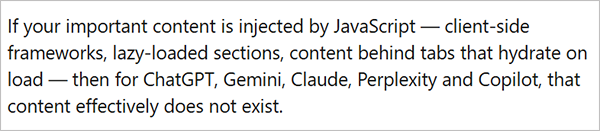
Sam Partland has also provided a few suggestions, of which one is worth mentioning.
“Server-side render your primary content and internal linking, and you’re safe for search engines and LLMs.”
Also, related discussions have surfaced in discussion forums. In a Reddit discussion, the user raised the issue that his site is not being crawled by AI because it does not have server-side rendering. In response, a verified professional replied:

This tweak can work as one of the LLM optimization techniques.
In a Nutshell
The AI crawlers’ JavaScript links study, and the past experiences and opinions of the digital marketers suggest that server-rendered HTML comes out as a sine qua non to handle the JavaScript crawlability issue.
Always remember SEO is necessary for AI visibility, be it on-page, off-page, or technical.
Next read: How to Track Traffic From Google AI Overviews: GSC vs GA4

Leave a Comment
Your email address will not be published. Required fields are marked *