

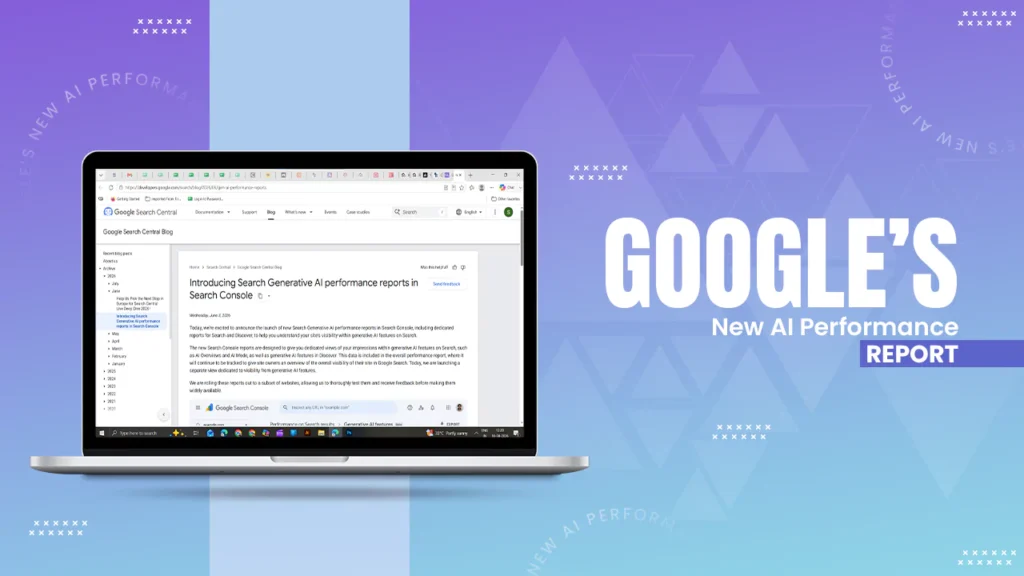
Google announced the release of Generative AI Performance Reports in Google Search Console through its document titled “Introducing Search Generative AI performance reports in Search Console” published on 3rd June 2026.
It aims to exhibit the core KPIs of websites’ performance on Google AI features. However, there have been some noteworthy features and some reported gaps raised by users that have drawn attention.
Here is a complete analysis of the report with its strengths and flaws and what the digital marketing community has opined about it.
The Google Search Console Generative AI Performance Report
Google Search Console generative AI performance report is a new tool to gauge the performance of the website over Google AI Overview and AI mode. However, it doesn’t include the data from Gemini.
Users can access it in Google Search Console by following the instructions:
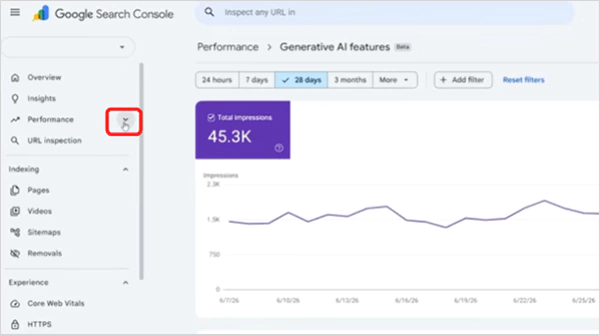
Step 1: Go to your Search Console and click on the drop-down button near the “Performance” tab on the left of the dashboard.
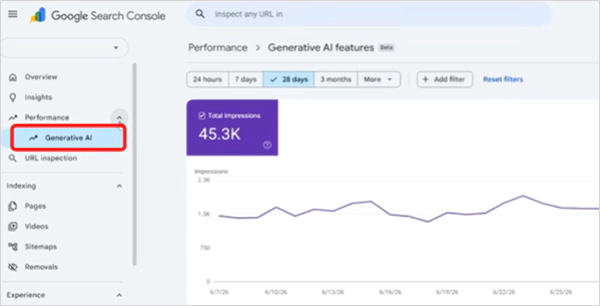
Step 2: Select “Generative AI” in the drop-down, and the report will load in the dashboard.
Suggested Read: Why Does AI Search Prefer Original Research Citations? Possible Gaps and Solutions
Although the report was not accessible to all GSC users as it was getting rolled out gradually, now there are some updates about all search console users discovering it on their dashboard.
Also, the websites with insufficient impressions from the Google AI feature might not get this report.
Despite having certain much-needed features, it has triggered debates for lacking some of its most expected KPIs.
What the Report Shows
The Google Search Console generative AI performance report provides data about the following dimensions.
- Impressions: The frequency of a URL appearing in AI features.
- Pages: Record of the URLs that appeared on Google AI features.
- Countries: Segregate the data based on the countries where the query has been made.
- Dates: Arrange data by day, week, or month.
- Devices: Group data based on the device used while making the query (desktop, tablet, or mobile).
Here is how these features will appear in the report.
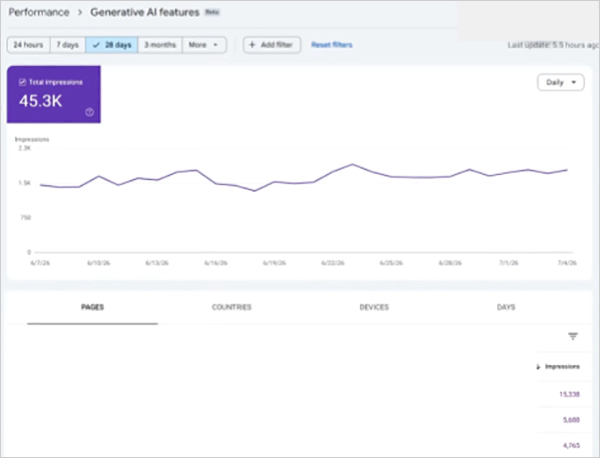
The data provided in the reports is presented in a chart and table form to ease users in understanding the trends.
What It Is Lacking
After its release, users have found certain shortcomings that hamper the expected utility of these reports. It does not include:
- Queries for which the pages appeared.
- Clicks data.
- Data from other prominent LLMs like ChatGPT, Gemini, Perplexity, etc.
Another issue here is with the calculation of the impressions. Let’s say 2 pages of your website appeared on a single AI results page. Then the search report will consider it 1 impression. However, 2 impressions will be counted on the discovery report for the same situation.
We have learned in the past few months that Google is diverting immense attention toward harnessing the potential of AI in its reporting systems, like the Google AI opt-out toggle and AI Configuration on Google Search Console.
These improvements indicate that the Google Search Console generative AI performance report might get a revamp to overcome its flaws in the coming times.
The Digital Marketers’ Views
Aleyda Solis, a renowned SEO and AI search consultant, has clearly stated that the report does not include the prompts/topics information or clicks data, but has also called it a good start.
Besides, the debate has just erupted on discussion forums, of which one Reddit discussion asking about the usefulness of the report is worth citing here.
The replies are even more productive, with some Reddit-verified professional hinting at its futility.

But Joshua Maraney, a Google Ads and SEO expert, has explicitly said that Google might show the lacking KPIs soon.
Concluding Remarks
Google Search Console generative AI performance report might have some shortcomings, but the available KPIs can be used smartly to structure the SEO strategy. Now the AI traffic analysis on GSC and GA4 is complementarily enhancing the workflow by providing better information about the website performance on AI platforms.
As said earlier, Google might add the missing features in future to make this report more productive.
Next Read: What Can SEOs Learn From Google’s 15.7 Million AI Mode Citation Study?

Leave a Comment
Your email address will not be published. Required fields are marked *